Tuesday, 15 October 2013

Spectators at the Picnic War and Other New Stuff

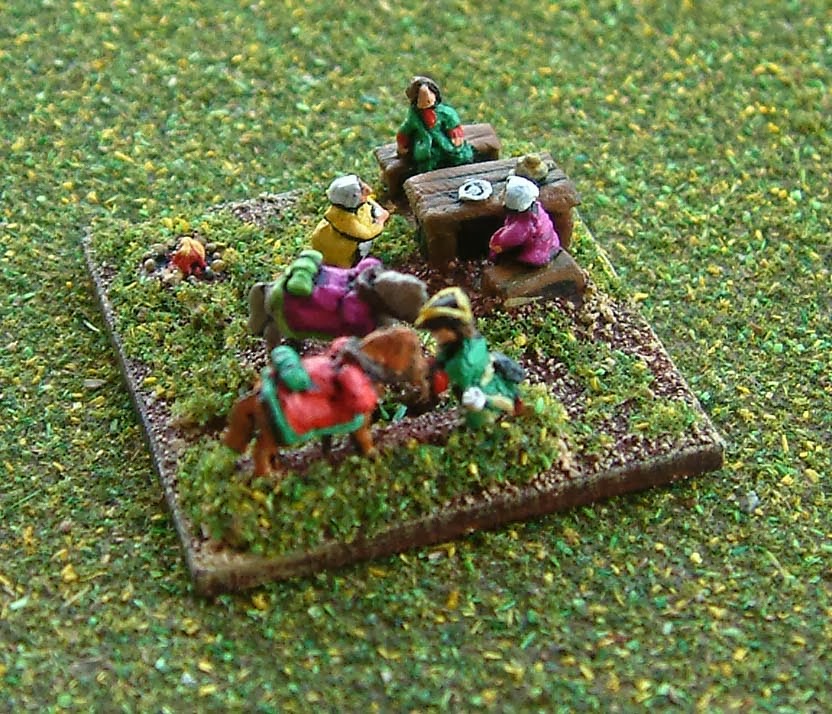
I am a sucker for making nice markers for my games, and for games with extras, as it were. Following the production of my objective marker for the Swedish GNW army, I decided to make a morale tracker for Maurice too.

The Morale Tracker
The scene: Outside a small country inn in Pommedeterrania, Nord Sachsen.

"Don't you two have anything better to do with your day?" Frau Brauerinne asked the two gentlemen that were were only customers at his unearthly hour of the morning.
"But Frau Brauerinne," protested Herr Rotearmee, "How could we have anything better to do on a fine Tuesday morning than sit outside your inn with our wargame, while the armies of Geataland and Shortengrad gather on the plain before us?"
"Indeed," added Herr Blaupants, "Your ale is the finest in the region, the weather is good and we have a grand entertainment before us. What else could be better?"
"What is more," appended his colleague, "We have here on our table the finest in kriegsspiel. We can model the battle that is about to be fought over the honour of Miss van Frufru based on the dispositions of the two armies as we observe them."
"Yes," continued Herr Blaupants, "It will be a grand entertainment, and when the citizens of Bad Reinigung come out to observe the battle, we can use our model to make a small fortune by betting on the outcome."
The two old gentlemen cackled heartily and toasted each other with steins of ale.
"Oh ..." Frau Brauerinne failed to finish her sentence, speechless. She waved her fist with frustration and stomped off.

Building found in a box at Caliver Books.
Figures and benches by Baccus 6mm.
Tree from Irregular Miniatures.
Dice frames from Minibits.

Other new stuff
Every so often I paint a Swedish army for the Seven Years War in 15mm. I have sold every other one that I have painted, but have started another one for our Pieces of Eight game that will one day see the light of day. These two units will be government musketeers in Pieces of Eight. I rather hope that I shall be able to expand this army to a full Maurice army too.
Upplands Regiment

Västerbottens Regiment
Figures are Freikorps 15 from LKM.

Tuesday, 8 October 2013

The Battle of Stamford Bridge, September 21st 2013.

I've been somewhat tardy in posting this report. I dragged my poor, long-suffering other half to Stamford Bridge on Sunday 21st September. The Battle of Stamford Bridge Society were spending the weekend commemorating the Battle of Stamford Bridge, which saw Harald hardrada defeated by Harold Godwinsson on 25th September 1066.

There were reenactors aplenty wandering around with tents set up and happy to talk to anyone with questions. The society had a small stall with information and some goodies to buy. Chris Rock (no, not that one) was selling his pamphlet/book on the battle, and there was barbeque to be had too. I'm looking forward to the 950th anniversary of this battle now and hope that this event expands significantly before then. Here are some photos to whet your appetite for all things Viking (and Saxon too, if you lean that way).

Warming up for the main event. There were demonstrations of all the melee weapons used by both sides
Facing the shieldwall
Viking food, but not a pickled herring in sight!
Part of the camp
Please park your longships only in the designated bays. Failure to comply will result in the issuing of a Fixed Penalty Notice
The Saxon standard
The Vikings arrive (apparently Tostig was delayed due to a hangover)
The Saxons arrive. They achieved surprise by sneaking up behind a hedge. I think they should have done that at Hastings too.
The Vikings form up for the battle
The whole of the camp area

Friday, 27 September 2013

How The Picnic War started

"Sir, I think you should look at this?"
"What is it, Svensson?"
"Sir, it appears to be Miss van Frufru."
"Egad, what's she doing here? Hand me my telescope."
All figures by Baccus 6mm
"By gad, Svensson, that's not just my Fifi. That's Count Ivan Bigunov too. And they appear to be having a picnic. Oh the poor girl. With what horrors has the threatened her that she sits there so quietly and makes no attempt to ride away? He must have lain in wait for her to be so prepared that he can lay on a picnic so replete with food. See, Svensson, how she takes a bite of his sausage, so unwillingly, and yet she chokes it down, for she is helpless in his clutches. See how Madame Cunegonde, Miss van Frufru's maid, must serve both the vile Count and my Fifi. See how Fifi must drink his vile wine and sample all the viands he has placed in front of her. She does well to give him no cause to strike her or worse. Oh, my Fifi, how brave you are to sit there so stoically. How courageously you fend off his detestable advances ... but wait ... what is this? Oh dear God, no! It cannot be! But I see with my own eyes that it is true. He ... has ... bagpipes! Will he now play the bagpipes with my Fifi? Alas, it must be so."

"Svensson, inform the army that we are no longer on exercise. We must to war for the honour of my poor Fifi, before the despicable Count can force her to learn to play the bagpipes."

My enthusiasm for eighteenth-century wargames, and indeed my painting mojo, which has languished for most of this year, has been rekindled by a game of Polemos the other day. We also plan to play Maurice, which requires me to have an objective marker. I looked online to see what others had done, and checked my ULP for suitable figures. In the end I resolved to do a picnic scene with the poor Miss Fifi van Frufru being serenaded by the foul, warty Count Ivan Bigunov. This is the result. It uses an early eighteenth century horseholder from a dragoons pack and some figures from one of the camp packs.


Monday, 23 September 2013

Today in the Man Cave

Over on my Talomir Tales blog, I featured a photo of the Tereken secret weapon in action:
Photobomb level: Cat
One of my cats, Victor, has a tendency to want to be involved in everything, so he photobombed the above shot. Now Javier of Javier at War wants a photo of him. Who am I to deny him this pleasure? Here are a couple of shots:
Victor likes to help me when I am trying to work and when I am taking a Facebook break. This is basically how my office looks today.

Victor also manages to curl up really small in one of his beds (yes he has multiple beds around the house)

Sunday, 8 September 2013

The Beer Standard

Sometimes I feel the need to justify my gaming purchases in terms other than their utility for planned games. Most recently I have applied this to board games, because figure games are justified by my endless arms race with Steve. Board games do not require one of us to buy an opposing force, so their purchase must be justified in terms of how much play they should get. To do this, I apply the beer standard.
The premise is quite simple and is based on the price of a pint of beer. I look at the playing time of the game and think how quickly I would normally drink a pint of beer. The rest is maths. Of course, this justification does not really hold now that I rarely get to the pub, but I still consider its application to be valid. Perhaps I should update it based on the price of a bottle of wine drunk at home instead ...


Anyway, changes in my lifestyle aside, it is a standard that has stood me in good stead for justifying buying games. One example of my need to justify games buying is in the area of Advanced Squad Leader modules. I really like ASL and bought into too many Third Party Publisher modules once I had the core modules. These days I only buy the new core modules and historical sets to keep up to date. I have literally thousands of scenarios kicking around and could probably play ASL every day for the rest of my life without repeating a scenario. With the core modules, I have 122 scenarios. Each will take on average about three hours to complete. Some are longer, while some are shorter, but three hours is probably a good average. That means that I have 366 hours of playing time. I used to drink a pint in the pub at a rate of about one per 20-30 minutes. That means that my expenditure on ASL core modules should have been between 732 pints and 1098 pints. At current local prices of £2.30 per pint, that equals an expenditure of between £1683.60 and £2525.40. That seems like ASL is good value to me.

What? You mean I should calculate it on the basis of actual playing time, not projected playing time? That does not sound useful to me. Oh well. Let's have a look at that. According to ROAR, the site where I have logged some of my games, I have played 47 games of ASL since 1999. I know that figure to be wrong, because there are gaps where I know I was at Intensive Fire, the big ASL tournament in Bournemouth. At one of those tournaments, I even played 13 games over one weekend. I did not get much sleep that time. So, I can safely double the 47 games played. I could probably triple it, but won't. Let's look at the recorded games. 47 games with an average playing time of three hours equals 141 hours or between 282 and 423 pints. At current beer prices, that means that my ASL habit is only justifiable if I have spent less than £650 on supplements. That's a bit close for comfort to what I have really spent. Let's double the number of games, because I think I can justify that. Less than £1300 on ASL modules? Yes, that sounds much better. My ASL habit is fully justified in terms of the beer standard, and is becoming even more justified because I have not spent much on it in recent years, while I am now getting more games played thanks to a new ASL friend moving into the area. So, the next time my wife asks if I really need a new module, I need only point out that I could be spending that much down the pub instead.

Wednesday, 4 September 2013

Heroic Sir Hugo defeats Sir Guy Le Batard - Warheads Battle Report

Over on the I've seen the light blog, Steve has recorded our latest game in doggerel verse. We played the first two scenarios from Warheads, which involved a duel at a bridge to get to grips with the combat system, followed by a raid on a grain store. Here is a taster photo to encourage you to visit Steve's blog.
Sir Hugo and Sir Guy meet at a bridge
Steve had made some terrain that perfectly suited the style of the Warheads figures. Top job. The Warheads rules were simple enough although there were a couple of questions about how the stats had been calculated for the minions. Based on our reading of the rules, they did not add up right. We plan to check that later. Even though there were some questions, the whole game was great fun and I totally got into character as Sir Hugo. For the record, I also totally diced Steve. It seemed that getting into character as the hero set the stage for a heroic victory.

Wednesday, 21 August 2013

An Analysis of Bwendi Military Forces on Beltene

Crikey, my last post on here was in May. That is months ago. Well, I guess I have been busy and we have not been gaming much lately, but that is still a pretty poor show on my part. Inspired by a post on Waystar High Port about the Imperial army in the sectors that he is building, I started to think what forces would be available to Steve and I in our quest for domination of Beltene. I have dealt previously (here, here and here) with lower level forces for the Bwendi, so this post makes a start on the larger formations available.

The first port of call was JTAS 10 as seen in kobold's post. I decided to use the table as written. So, we have a balkanised world with UWP: B 866673-9 Ag Ni Ri G630 Na. Tech Level is 9 and the Population is 6. This gives 15 battalions available on the world. Striker identifies battalions as approximately 500 people, so that means that of the six million inhabitants on this planet, 7500 are in the army. That does not sound like very large armies at all, when they have to be divided between two sides.

Striker II offers some additional thoughts on what is available: approximately 1% of a warlike population. Yes, both Bwendi and Albion count as warlike: the former because it is forced to defend itself against the latter all the time; the latter because it is always attacking the former. Using this figure, we see that about 60000 people are in the armed forces. Beltene has a high hydrographic percentage, so we shall use the highest figure suggested of 10% of the available forces being in the wet navy. Striker II suggests 20% to 30% in the air forces, which will include orbital and space operations in our case. Let's go with 25%. The remainder are in the army. Our force breakdown now looks like this:

  • Navy: 6000 personnel;
  • Aerospace Forces: 15000 personnel; and
  • Army: 39000 personnel.
Focusing on the army, Striker II offers a standard division equivalent of 20000 personnel, so let's count the army total as two division equivalents. A division equivalent includes 10 manoeuvre or combat battalions of 500 personnel each, 10 support battalions of 500 personnel each and 10000 personnel in the infrastructure behind these units. This means that there are 10000 front-line troops on Beltene, which is slightly higher than the JTAS figure gives, but I am happy to go with it, because it suits how I envisage the state of Beltene with all that Albion aggression going on. So, what does this mean for the Bwendi?

We divide the numbers in half to give the personnel available to each side. Both nations have 30500 personnel involved in their armed forces (rounding up to make the numbers work the way I want. I'll just increase the population to suit later.). I don't know how Steve will want to break his forces down, but I am happy to go with percentages like those given in Striker II.

The Bwendi Navy
It has 3000 personnel, of whom about half will be infrastructure and one quarter will be support troops running cargo and supply vessels. That leaves a front-line force of 750 personnel for me to crew ships with. That is about enough to crew a WW2 light cruiser. I don't envisage traditional capital ships as part of the world's background, because technology changes mean that smaller ships can pack a higher punch. Also, the action is all focused around the one land mass so far, which means that sea-going vessels are not entirely necessary. Additionally, aerospace forces would probably make them too vulnerable, so the navy will consist of smaller vessels equivalent to modern guided missile destroyers and fast attack craft. With the number of crew available, I imagine that the navy will have two to four destroyers (each with a crew of 100 to 150 personnel) and maybe a dozen fast attack craft (each with a crew of 25 to 30 personnel). I need to look at what inspiration and models are available to make a final decision on this though. Still, it will be fun to bombard Avalondon from sea once we get a proper war going on Beltene.

The Bwendi Aerospace Patrol
The BAP has 7500 personnel, of whom 1500 are frontline crew. These are divided between the crews of pure aircraft, space fighters and bombers, and system defence craft. I need to start designing craft to work out what is available in total.

The Bwendi Republican Army
This consists of 20000 personnel, of whom 5000 are front-line troops. Striker II offers percentages for troop morale and equipment quality. Using these, I can expect that I shall have:
  • 2000 experienced (i.e. regular) troops;
  • 2500 veteran troops; and
  • 500 elite troops.
I can also expect to have:
  • 2000 poorly-equipped troops;
  • 2500 averagely-equipped troops; and
  • 500 well-equipped troops.
I shall give the best equipment to the best-trained troops. The backbone of the army is the veteran troops with extensive combat experience in the many brushfire wars of Beltene. These are the armoured infantry of the regular army. A Bwendi armoured infantry company consists of 149 troops, so a battalion of three companies will have 447 troops and will need a battalion command unit. I shall also allow for battalion-level weapons teams of unspecified type (at least until I find some models I really like) and add a Scout platoon of three scout teams (total of 18 troops). The battalion troops will also need some heavier EW/ECW troops. Based on the standard AFV, each section will have no more than nine troops plus the AFV crew of two. The weapons teams will probably be three or four crew per weapon. Assuming towed weapons with indirect fire capability, I shall allow for a battery of three, each with its own transport AFV. The final battalion consists of:
  • 1 Battalion Command Section (6 troops, 1 AFV)
  • 1 Battalion Communications and Electronic Warfare Team (8 troops, 2 AFVs)
  • 1 Battalion Heavy Support Battery (18 troops, 3 AFVs, 3 heavy support weapons)
  • 1 Scout Platoon (18 troops, 9 scout vehicles)
  • 3 Armoured Infantry Companies (447 troops, 52 AFVs)
That's 497 troops, which fits well with the Striker II numbers. A regiment will then have three battalions, being around 1500 troops with the regimental command unit. As you can see, I am short one battalion to produce two regiments, so I shall include in one of the regiments a battalion of experienced troops with poorer equipment. These are the newer recruits. Having a percentage of the regular army with poor equipment indicates that a percentage of their transport vehicles may be in for repair or have been knocked out and not replaced yet.

A tank battalion will consist of three tank companies, each with three tank platoons and an armoured scout platoon. The basic tank platoon has 8 tanks with a total of 31 crew. The company command consists of a command tank and an armoured communications vehicle (2 vehicles, 7 crew), bringing the company size to 100 crew. The armoured scout platoon consists of 3 scout troops each with 3 light tanks (9 light tanks, 27 crew). The battalion probably needs a heavy weapons platoon. I like the idea of an MLRS system, so we shall have a battery of three of those (3 vehicles, 12 crew, and now I know what my next purchase from GZG will be!). Battalion command will consist of a command tank and a communications vehicle just like the company command. The battalion will consist of:
  • 1 Battalion Command Troop (2 vehicles, 7 crew);
  • 1 Battalion Heavy Support Battery (3 vehicles, 12 crew)
  • 1 Armoured Scout Platoon (9 tanks, 27 crew)
  • 3 Tank Companies (26 tanks, 300 crew)
That gives me a well-equipped battalion consisting of 346 crew, leaving me space for adding an airmobile elite company of around 100 troops and a small commando force.

The remaining 1500 troops are members of the Bwendi Uniform Militia Regiments. BUM units are generally organised on a local level with the number of platoons present being determined by the local population rather than military necessity. Their role is usually local defence but the overall nominal organisation of the BUM battalion is as follows:
  • 1 Battalion Command Section (5 personnel)
  • 3 Infantry Companies (285 personnel)
A regiment consists of 3 battalions with a regimental command section of 5 men for a total of 870 personnel. The astute will notice that the militia regiment numbers exceed the total available personnel. Most militia units are below strength so the total strength of both regiments is approximately 1500 personnel. Heavy support for the militia is provided by the regular army and transport generally consists of whatever is available in the local area, although a pool of army trucks is available in some areas. It is not unknown for some BUMs to drive their section into battle in their own personal vehicles.

So, now I know that the Bwendi army consists of:
  • 2 understrength Militia Regiments;
  • 2 Armoured Infantry Regiments;
  • 1 Tank Battalion;
  • 1 Airmobile Company; and
  • 1 Special Forces Commando.

Using all this in games
The following ideas are ways to incorporate the above meanderings into scenario design and game play. They have not been tested and are likely to change as I develop the army further.

At the start of the game, assemble a full strength force of the appropriate type as determined by the scenario, and then dice according to type using the numbers outlined below to see what quality the troops are and what equipment is available or missing.

Armoured Infantry:
Dice for all vehicles using 1d6. On a 6, the vehicle is not available.

Troop Quality (1d10):
1-2 Experienced
3-9 Veteran
10 Elite

Militia Infantry:
Dice for each figure/stand (depending on rules in use) using 1d10. On an 8 or 9, that figure/stand is not available for the current battle.

Dice for each section using 1d6. On a 6, enough vehicles are available to carry that section, otherwise it walks.

Troop Quality (1d10):
1-8 Experienced
9-10 Veteran

Tank Units:
Troop Quality (1d10):
1 Experienced
2-7 Veteran
8-10 Elite

Airmobile:
Always have transport.

Troop Quality (1d10):
1-6 Veteran
7-10 Elite

Special Forces:
Always have transport if needed.
Always Elite