 |
| Victor (left) and Jasmine |
Sunday, 27 October 2013
Lack of Progress
I have been painting some Irregular Miniatures 6mm WW1 French troops for our planned 1914 campaign next year. I have also done a little more work on expanding the 15mm Pieces of Eight/ Maurice army. However, progress is slow and painting time is limited, so they are not finished and ready for photographing yet. I am also finding that I am not motivated to paint much at the moment, so, instead, here is a photo of my cats. Javier asked for cat pictures, so blame him. :)

Saturday, 19 October 2013
Maurice - The First Battle and First Impressions
We played Maurice last week. It was out first time out with the rules and we were interested to see how they worked. For those that do not know, Maurice uses a card draw system instead of rolling dice for command points or just permitting you to move everything at one go.
Each player starts with a hand of cards, which have a number in their top left corner. This number is the distance in base widths from the general, that a force (group of units) may be activated. To activate a force, you measure the distance to the force from the general and play a number of cards whose value equals or exceeds that distance. The actions you take determine how many new cards you may draw on that turn. If you charge, you get no cards; if you pass you get three cards; and other actions permit you to draw one or two cards to replenish your hand. This means that attacking is difficult because you can quickly run out of cards and thus the attack loses momentum.
The game is very much about hand management then. Maurice also uses a system of alternate activation. The first player activates a unit or force, and then the second player does the same. Repeat until the battle is over. However, you are not restricted to only activating units that have not previously been activated. Instead, you can activate the same force continuously until it is annihilated or runs out of steam. This permits grand flanking manoeuvres at the expense of the rest of your army standing still.
Steve brought his newly painted Russian Great Northern War army round, while I used my Swedish GNW army. For the sake of simplicity, we ignored pikes and early eighteenth-century artillery rules, which are in Maurice for just this period.
We chose to play a standard encounter battle and adopted the set-up procedure from the free Maurice Lite rules, although we used the full rules for everything else. Steve chose lots of infantry, while I chose a force with a balance of infantry and cavalry.
We began with a bombardment on both sides, which gave us a chance to cause some disruption to the enemy, while also building our hands up to permit an assault. The cotton wool in front of the guns not only looks cool, but it is also a marker showing that the guns cannot move without being given a march order first. The Russians charged first.
Although they succeed in causing more damage to the enemy than they suffered, the Russian cavalry assault stalled because they were too far from their general and Steve quickly ran out of cards trying to press the assault. This gave me a chance to rally my troops, who were closer to my general, and then to throw them back at the tired Russian cavalry.
In the end, this first assault saw two of the Russian cavalry units and one of the Swedish units routed. I managed to gain the advantage, but my dice rolling was very low throughout this game, so I did not do as well as I should.
Meanwhile, in the centre, Steve advanced his infantry, only to find a previously unseen bog in his way. Some cards permit you to play events instead of using them for command purposes. One of these is the much complained about "how did that get there?" card, which allows you to place a small area of rough going at any point on the battlefield. I got it and used it to slow Steve's advance. The rest of Steve's infantry managed to advance and drive off one of my infantry regiments at the cost of one of his own. By this point I was cursing my dice and threatening them with a watery grave, because I could only roll low and cause minimal casualties, while he seemed to be rolling high for everything.
On the right flank, things were a bit different. My cavalry charged and drove off his cavalry. They then turned and prepared to charge the flank of his infantry, who were slowed by the bog, and his artillery, who looked ripe for the picking. It was also at this point that I got too excited with the game and forgot to take any more photos!
As it turned out, Steve's high rolling did for him. Each army has a morale total. When units rout you dice to see how many moral points the army loses. Steve's high rolling throughout the game caused his army's morale to disappear in a welter of high rolls. Although I took more casualties, my low rolling also meant that my army stood firm. I had lost more units but retained my morale and won the day. Huzzah!
Opinion
So, what did we think of the rules?
The hand management aspect is rather good. It forces you to consider your priorities and plan ahead. It also meant that the game had a rather stately pace as we acted, paused to recover/draw cards and then acted again. Assaults petered out as cards ran out, and both sides had to step back to recover. This felt right for the period.
The activation system was good. Being able to repeatedly activate one force was both a blessing and a curse. It meant that you could get lost in trying to push one part of your plan while forgetting about the rest. Also, if you focused on a flank and moved your general over there to make it easier, then you were in trouble if your other flank was attacked, because it would cost a lot cards to respond.
Overall, the pace and structure of the game worked for us. We enjoy games where you have to plan several moves in advance to be able to carry out your plans, and this is one of those games. You cannot simply react as you might in a lot of other games. We are looking forward to our next game now. I can still imagine using Polemos: GNW for historical games and these more for imagi-nation games, but it will be interesting to try a historical refight or two with Maurice.
I think that these rules will work well with C. S. Grant's Scenarios for Wargames, and I plan to string several of them together as a mini-campaign, once we are suitably au fait with the rules. I am also keen to try them with Grant's Programmed Wargames Scenarios. They have the right Olde Skool feel to them, which is good.
Anyway, I would suggest giving Maurice a try, if you are interested in the first half of the eighteenth century. Now I must also consider how to include the devices and engines of our Lacepunk game in Maurice terms. Hmmm ...
Each player starts with a hand of cards, which have a number in their top left corner. This number is the distance in base widths from the general, that a force (group of units) may be activated. To activate a force, you measure the distance to the force from the general and play a number of cards whose value equals or exceeds that distance. The actions you take determine how many new cards you may draw on that turn. If you charge, you get no cards; if you pass you get three cards; and other actions permit you to draw one or two cards to replenish your hand. This means that attacking is difficult because you can quickly run out of cards and thus the attack loses momentum.
The game is very much about hand management then. Maurice also uses a system of alternate activation. The first player activates a unit or force, and then the second player does the same. Repeat until the battle is over. However, you are not restricted to only activating units that have not previously been activated. Instead, you can activate the same force continuously until it is annihilated or runs out of steam. This permits grand flanking manoeuvres at the expense of the rest of your army standing still.
Steve brought his newly painted Russian Great Northern War army round, while I used my Swedish GNW army. For the sake of simplicity, we ignored pikes and early eighteenth-century artillery rules, which are in Maurice for just this period.
 |
| The view from the Russian lines at the start of the battle |
 |
| Russian cavalry open the assault with a charge on the Swedish left wing. |
 |
| The Russian charge stalls |
 |
| Russians charge in the centre, while the Swedish cavalry clears the right flank |
Meanwhile, in the centre, Steve advanced his infantry, only to find a previously unseen bog in his way. Some cards permit you to play events instead of using them for command purposes. One of these is the much complained about "how did that get there?" card, which allows you to place a small area of rough going at any point on the battlefield. I got it and used it to slow Steve's advance. The rest of Steve's infantry managed to advance and drive off one of my infantry regiments at the cost of one of his own. By this point I was cursing my dice and threatening them with a watery grave, because I could only roll low and cause minimal casualties, while he seemed to be rolling high for everything.
On the right flank, things were a bit different. My cavalry charged and drove off his cavalry. They then turned and prepared to charge the flank of his infantry, who were slowed by the bog, and his artillery, who looked ripe for the picking. It was also at this point that I got too excited with the game and forgot to take any more photos!
As it turned out, Steve's high rolling did for him. Each army has a morale total. When units rout you dice to see how many moral points the army loses. Steve's high rolling throughout the game caused his army's morale to disappear in a welter of high rolls. Although I took more casualties, my low rolling also meant that my army stood firm. I had lost more units but retained my morale and won the day. Huzzah!
Opinion
So, what did we think of the rules?
The hand management aspect is rather good. It forces you to consider your priorities and plan ahead. It also meant that the game had a rather stately pace as we acted, paused to recover/draw cards and then acted again. Assaults petered out as cards ran out, and both sides had to step back to recover. This felt right for the period.
The activation system was good. Being able to repeatedly activate one force was both a blessing and a curse. It meant that you could get lost in trying to push one part of your plan while forgetting about the rest. Also, if you focused on a flank and moved your general over there to make it easier, then you were in trouble if your other flank was attacked, because it would cost a lot cards to respond.
Overall, the pace and structure of the game worked for us. We enjoy games where you have to plan several moves in advance to be able to carry out your plans, and this is one of those games. You cannot simply react as you might in a lot of other games. We are looking forward to our next game now. I can still imagine using Polemos: GNW for historical games and these more for imagi-nation games, but it will be interesting to try a historical refight or two with Maurice.
I think that these rules will work well with C. S. Grant's Scenarios for Wargames, and I plan to string several of them together as a mini-campaign, once we are suitably au fait with the rules. I am also keen to try them with Grant's Programmed Wargames Scenarios. They have the right Olde Skool feel to them, which is good.
Anyway, I would suggest giving Maurice a try, if you are interested in the first half of the eighteenth century. Now I must also consider how to include the devices and engines of our Lacepunk game in Maurice terms. Hmmm ...
Tuesday, 15 October 2013
Spectators at the Picnic War and Other New Stuff
I am a sucker for making nice markers for my games, and for games with extras, as it were. Following the production of my objective marker for the Swedish GNW army, I decided to make a morale tracker for Maurice too.
The Morale Tracker
The scene: Outside a small country inn in Pommedeterrania, Nord Sachsen.
"Don't you two have anything better to do with your day?" Frau Brauerinne asked the two gentlemen that were were only customers at his unearthly hour of the morning.
"But Frau Brauerinne," protested Herr Rotearmee, "How could we have anything better to do on a fine Tuesday morning than sit outside your inn with our wargame, while the armies of Geataland and Shortengrad gather on the plain before us?"
"Indeed," added Herr Blaupants, "Your ale is the finest in the region, the weather is good and we have a grand entertainment before us. What else could be better?"
"What is more," appended his colleague, "We have here on our table the finest in kriegsspiel. We can model the battle that is about to be fought over the honour of Miss van Frufru based on the dispositions of the two armies as we observe them."
"Yes," continued Herr Blaupants, "It will be a grand entertainment, and when the citizens of Bad Reinigung come out to observe the battle, we can use our model to make a small fortune by betting on the outcome."
The two old gentlemen cackled heartily and toasted each other with steins of ale.
"Oh ..." Frau Brauerinne failed to finish her sentence, speechless. She waved her fist with frustration and stomped off.
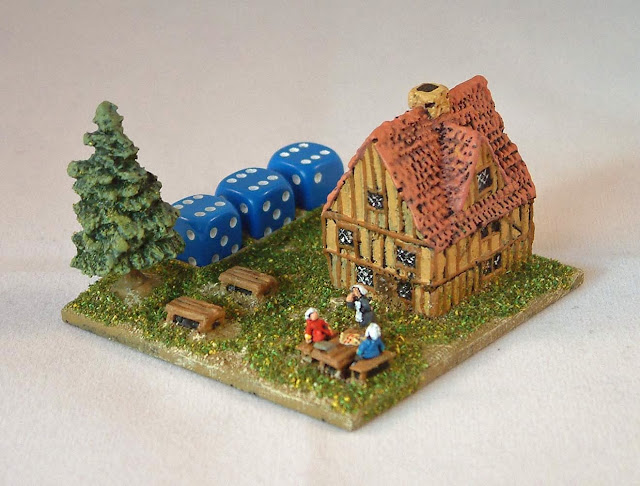
Building found in a box at Caliver Books.
Figures and benches by Baccus 6mm.
Tree from Irregular Miniatures.
Dice frames from Minibits.
Other new stuff
Every so often I paint a Swedish army for the Seven Years War in 15mm. I have sold every other one that I have painted, but have started another one for our Pieces of Eight game that will one day see the light of day. These two units will be government musketeers in Pieces of Eight. I rather hope that I shall be able to expand this army to a full Maurice army too.
Figures are Freikorps 15 from LKM.
The Morale Tracker
The scene: Outside a small country inn in Pommedeterrania, Nord Sachsen.
"Don't you two have anything better to do with your day?" Frau Brauerinne asked the two gentlemen that were were only customers at his unearthly hour of the morning.
"But Frau Brauerinne," protested Herr Rotearmee, "How could we have anything better to do on a fine Tuesday morning than sit outside your inn with our wargame, while the armies of Geataland and Shortengrad gather on the plain before us?"
"Indeed," added Herr Blaupants, "Your ale is the finest in the region, the weather is good and we have a grand entertainment before us. What else could be better?"
"What is more," appended his colleague, "We have here on our table the finest in kriegsspiel. We can model the battle that is about to be fought over the honour of Miss van Frufru based on the dispositions of the two armies as we observe them."
"Yes," continued Herr Blaupants, "It will be a grand entertainment, and when the citizens of Bad Reinigung come out to observe the battle, we can use our model to make a small fortune by betting on the outcome."
The two old gentlemen cackled heartily and toasted each other with steins of ale.
"Oh ..." Frau Brauerinne failed to finish her sentence, speechless. She waved her fist with frustration and stomped off.

Building found in a box at Caliver Books.
Figures and benches by Baccus 6mm.
Tree from Irregular Miniatures.
Dice frames from Minibits.
Other new stuff
Every so often I paint a Swedish army for the Seven Years War in 15mm. I have sold every other one that I have painted, but have started another one for our Pieces of Eight game that will one day see the light of day. These two units will be government musketeers in Pieces of Eight. I rather hope that I shall be able to expand this army to a full Maurice army too.
 |
| Upplands Regiment |
 |
| Västerbottens Regiment |
Tuesday, 8 October 2013
The Battle of Stamford Bridge, September 21st 2013.
I've been somewhat tardy in posting this report. I dragged my poor, long-suffering other half to Stamford Bridge on Sunday 21st September. The Battle of Stamford Bridge Society were spending the weekend commemorating the Battle of Stamford Bridge, which saw Harald hardrada defeated by Harold Godwinsson on 25th September 1066.
There were reenactors aplenty wandering around with tents set up and happy to talk to anyone with questions. The society had a small stall with information and some goodies to buy. Chris Rock (no, not that one) was selling his pamphlet/book on the battle, and there was barbeque to be had too. I'm looking forward to the 950th anniversary of this battle now and hope that this event expands significantly before then. Here are some photos to whet your appetite for all things Viking (and Saxon too, if you lean that way).
There were reenactors aplenty wandering around with tents set up and happy to talk to anyone with questions. The society had a small stall with information and some goodies to buy. Chris Rock (no, not that one) was selling his pamphlet/book on the battle, and there was barbeque to be had too. I'm looking forward to the 950th anniversary of this battle now and hope that this event expands significantly before then. Here are some photos to whet your appetite for all things Viking (and Saxon too, if you lean that way).
 |
| Warming up for the main event. There were demonstrations of all the melee weapons used by both sides |
 |
| Facing the shieldwall |
 |
| Viking food, but not a pickled herring in sight! |
 |
| Part of the camp |
 |
| Please park your longships only in the designated bays. Failure to comply will result in the issuing of a Fixed Penalty Notice |
 |
| The Saxon standard |
 |
| The Vikings arrive (apparently Tostig was delayed due to a hangover) |
 |
| The Saxons arrive. They achieved surprise by sneaking up behind a hedge. I think they should have done that at Hastings too. |
 |
| The Vikings form up for the battle |
 |
| The whole of the camp area |
Friday, 27 September 2013
How The Picnic War started
"Sir, I think you should look at this?"
"What is it, Svensson?"
"Sir, it appears to be Miss van Frufru."
"Egad, what's she doing here? Hand me my telescope."
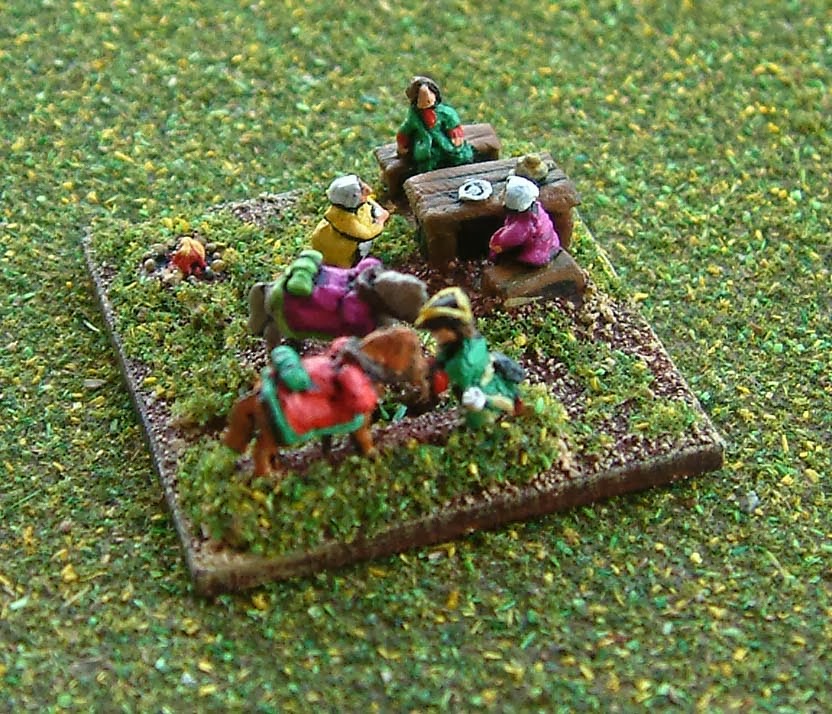
"By gad, Svensson, that's not just my Fifi. That's Count Ivan Bigunov too. And they appear to be having a picnic. Oh the poor girl. With what horrors has the threatened her that she sits there so quietly and makes no attempt to ride away? He must have lain in wait for her to be so prepared that he can lay on a picnic so replete with food. See, Svensson, how she takes a bite of his sausage, so unwillingly, and yet she chokes it down, for she is helpless in his clutches. See how Madame Cunegonde, Miss van Frufru's maid, must serve both the vile Count and my Fifi. See how Fifi must drink his vile wine and sample all the viands he has placed in front of her. She does well to give him no cause to strike her or worse. Oh, my Fifi, how brave you are to sit there so stoically. How courageously you fend off his detestable advances ... but wait ... what is this? Oh dear God, no! It cannot be! But I see with my own eyes that it is true. He ... has ... bagpipes! Will he now play the bagpipes with my Fifi? Alas, it must be so."
"Svensson, inform the army that we are no longer on exercise. We must to war for the honour of my poor Fifi, before the despicable Count can force her to learn to play the bagpipes."
My enthusiasm for eighteenth-century wargames, and indeed my painting mojo, which has languished for most of this year, has been rekindled by a game of Polemos the other day. We also plan to play Maurice, which requires me to have an objective marker. I looked online to see what others had done, and checked my ULP for suitable figures. In the end I resolved to do a picnic scene with the poor Miss Fifi van Frufru being serenaded by the foul, warty Count Ivan Bigunov. This is the result. It uses an early eighteenth century horseholder from a dragoons pack and some figures from one of the camp packs.


"What is it, Svensson?"
"Sir, it appears to be Miss van Frufru."
"Egad, what's she doing here? Hand me my telescope."
 |
| All figures by Baccus 6mm |
"Svensson, inform the army that we are no longer on exercise. We must to war for the honour of my poor Fifi, before the despicable Count can force her to learn to play the bagpipes."
My enthusiasm for eighteenth-century wargames, and indeed my painting mojo, which has languished for most of this year, has been rekindled by a game of Polemos the other day. We also plan to play Maurice, which requires me to have an objective marker. I looked online to see what others had done, and checked my ULP for suitable figures. In the end I resolved to do a picnic scene with the poor Miss Fifi van Frufru being serenaded by the foul, warty Count Ivan Bigunov. This is the result. It uses an early eighteenth century horseholder from a dragoons pack and some figures from one of the camp packs.

Monday, 23 September 2013
Today in the Man Cave
Over on my Talomir Tales blog, I featured a photo of the Tereken secret weapon in action:
One of my cats, Victor, has a tendency to want to be involved in everything, so he photobombed the above shot. Now Javier of Javier at War wants a photo of him. Who am I to deny him this pleasure? Here are a couple of shots:
 |
| Photobomb level: Cat |
 |
| Victor likes to help me when I am trying to work and when I am taking a Facebook break. This is basically how my office looks today. |
 |
| Victor also manages to curl up really small in one of his beds (yes he has multiple beds around the house) |
Sunday, 8 September 2013
The Beer Standard
Sometimes I feel the need to justify my gaming purchases in terms other than their utility for planned games. Most recently I have applied this to board games, because figure games are justified by my endless arms race with Steve. Board games do not require one of us to buy an opposing force, so their purchase must be justified in terms of how much play they should get. To do this, I apply the beer standard.
 The premise is quite simple and is based on the price of a pint of beer. I look at the playing time of the game and think how quickly I would normally drink a pint of beer. The rest is maths. Of course, this justification does not really hold now that I rarely get to the pub, but I still consider its application to be valid. Perhaps I should update it based on the price of a bottle of wine drunk at home instead ...

Anyway, changes in my lifestyle aside, it is a standard that has stood me in good stead for justifying buying games. One example of my need to justify games buying is in the area of Advanced Squad Leader modules. I really like ASL and bought into too many Third Party Publisher modules once I had the core modules. These days I only buy the new core modules and historical sets to keep up to date. I have literally thousands of scenarios kicking around and could probably play ASL every day for the rest of my life without repeating a scenario. With the core modules, I have 122 scenarios. Each will take on average about three hours to complete. Some are longer, while some are shorter, but three hours is probably a good average. That means that I have 366 hours of playing time. I used to drink a pint in the pub at a rate of about one per 20-30 minutes. That means that my expenditure on ASL core modules should have been between 732 pints and 1098 pints. At current local prices of £2.30 per pint, that equals an expenditure of between £1683.60 and £2525.40. That seems like ASL is good value to me.
What? You mean I should calculate it on the basis of actual playing time, not projected playing time? That does not sound useful to me. Oh well. Let's have a look at that. According to ROAR, the site where I have logged some of my games, I have played 47 games of ASL since 1999. I know that figure to be wrong, because there are gaps where I know I was at Intensive Fire, the big ASL tournament in Bournemouth. At one of those tournaments, I even played 13 games over one weekend. I did not get much sleep that time. So, I can safely double the 47 games played. I could probably triple it, but won't. Let's look at the recorded games. 47 games with an average playing time of three hours equals 141 hours or between 282 and 423 pints. At current beer prices, that means that my ASL habit is only justifiable if I have spent less than £650 on supplements. That's a bit close for comfort to what I have really spent. Let's double the number of games, because I think I can justify that. Less than £1300 on ASL modules? Yes, that sounds much better. My ASL habit is fully justified in terms of the beer standard, and is becoming even more justified because I have not spent much on it in recent years, while I am now getting more games played thanks to a new ASL friend moving into the area. So, the next time my wife asks if I really need a new module, I need only point out that I could be spending that much down the pub instead.


Anyway, changes in my lifestyle aside, it is a standard that has stood me in good stead for justifying buying games. One example of my need to justify games buying is in the area of Advanced Squad Leader modules. I really like ASL and bought into too many Third Party Publisher modules once I had the core modules. These days I only buy the new core modules and historical sets to keep up to date. I have literally thousands of scenarios kicking around and could probably play ASL every day for the rest of my life without repeating a scenario. With the core modules, I have 122 scenarios. Each will take on average about three hours to complete. Some are longer, while some are shorter, but three hours is probably a good average. That means that I have 366 hours of playing time. I used to drink a pint in the pub at a rate of about one per 20-30 minutes. That means that my expenditure on ASL core modules should have been between 732 pints and 1098 pints. At current local prices of £2.30 per pint, that equals an expenditure of between £1683.60 and £2525.40. That seems like ASL is good value to me.
What? You mean I should calculate it on the basis of actual playing time, not projected playing time? That does not sound useful to me. Oh well. Let's have a look at that. According to ROAR, the site where I have logged some of my games, I have played 47 games of ASL since 1999. I know that figure to be wrong, because there are gaps where I know I was at Intensive Fire, the big ASL tournament in Bournemouth. At one of those tournaments, I even played 13 games over one weekend. I did not get much sleep that time. So, I can safely double the 47 games played. I could probably triple it, but won't. Let's look at the recorded games. 47 games with an average playing time of three hours equals 141 hours or between 282 and 423 pints. At current beer prices, that means that my ASL habit is only justifiable if I have spent less than £650 on supplements. That's a bit close for comfort to what I have really spent. Let's double the number of games, because I think I can justify that. Less than £1300 on ASL modules? Yes, that sounds much better. My ASL habit is fully justified in terms of the beer standard, and is becoming even more justified because I have not spent much on it in recent years, while I am now getting more games played thanks to a new ASL friend moving into the area. So, the next time my wife asks if I really need a new module, I need only point out that I could be spending that much down the pub instead.
Subscribe to:
Posts (Atom)