Showing posts with label TwoHourWargames. Show all posts

Monday, 28 June 2010

The Best of All Possible Mining Outposts - A 5150 report

Captain Pangloss of the Bwendi Levy was engrossed in his book when the alarm call came; he loved reading about his ancestor in Old Earth history books.

"Captain," yelled Sergeant Candide through the commlink, "We've got incoming. Unidentified space skimmer approaching. We don't recognise the type or the markings. Looks like it might not be ADF this time."
"Very well," responded Pangloss, "Sound the alarm and get your men deployed to meet them. They could be friendly but let's not take any chances."

The Levy stumbled over each other as they took up positions, but Pangloss was not too worried. The men might be green but they had the best of all possible commanders in Candide and Pangloss. Sgt Candide had taken half the men and was covering the left flank from the roof of one of the supply huts, while Pangloss and the rest of the men occupied the main command hut, which provided both good lines of sight and a comfortably fortified position from which to observe the approach of these newcomers. They did not have long to wait. Gunfire from Candide's position indicated that the newcomers were indeed hostile. Then the gunner spotted one of the enemy, as did Pangloss. Blimey, these were proper aliens and of a type that he had never previously encountered. They were huge and heavily armed. Pangloss opened fire at the alien, scoring multiple hits but it just kept coming until the gunner stitched a burst of fire all the way across its head. (click the pics for larger images)
Over the intercom, Pangloss could hear the shouts of Candide's men and Candide's orders. It all sounded rather chaotic, but that was for the best because, if it were not chaotic there, it would have to be chaotic somewhere else, as likely in Pangloss' ad hoc command bunker as anywhere else! As he thought this, suddenly a hail of automatic fire ripped into the walls of the hut and several shots came through the window, tearing chunks out of the gunner and his number two. Both men dropped in a pool of blood. Pangloss immediately raced over to grab the gun and keep it in action. It's firepower could be crucial. Then Private Thunder-Ten-Tronckh collapsed in another welter of automatic fire. Their position had been flanked and the troopers Pangloss had left outside had been dispatched rather too quietly. Over the commlink he could hear Candide rallying his men, who had lost their courage in the face of overwhelming enemy firepower. Candide was now manoeuvring to assault the enemy again. Perhaps he could flank them as Pangloss had been. Still, it was just as well that Pangloss had been flanked because otherwise it would have happened somewhere else and Pangloss was better able to deal with such a situation.
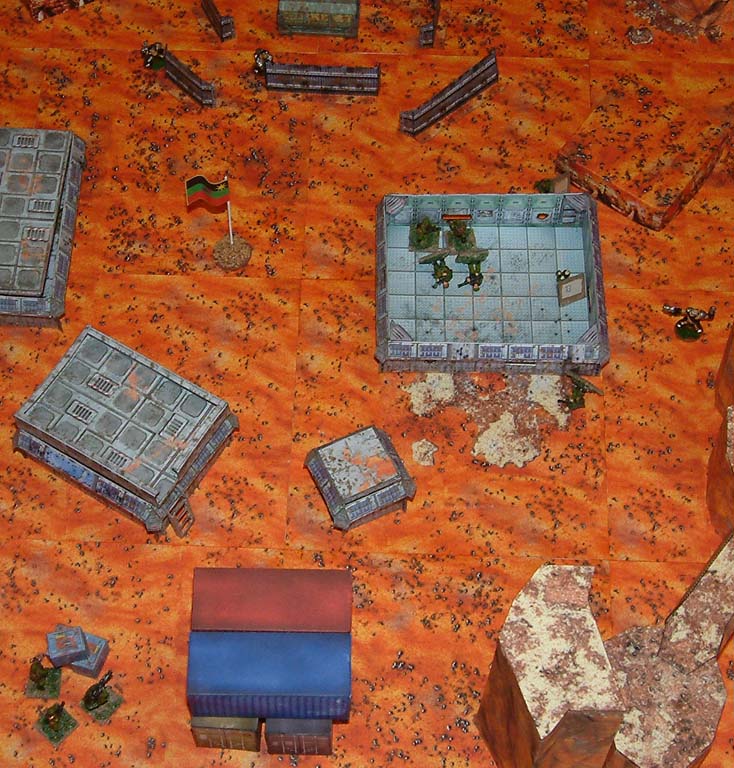
Candide's men were now moving into position as Pangloss sought out the cause of the problems round his own command. It turned out to be a single alien with two unfeasibly large machine pistols. Pangloss was impressed despite himself. Surely those must be the best of all possible machine pistols! That did not stop him letting rip with the LMG though. His burst of fire tore visible holes in the alien's armour and made it duck for cover. Unfortunately it did not appear to be hurt.
As Pangloss adopted a suitable firing position, the alien suddenly appeared at the window again. Private Cunegonde was frozen with fear and the alien dropped her where she stood, with her weapon unfired. Pangloss was alone in the hut. Over on the other flank, the cries of the wounded could be heard, as were the exhortations of the routed. It sounded like Candide's command was running for its life. That was probably for the best. Pangloss dropped back into the corner of the hut and prepared to resist the aliens when they came for him. He was the last of his command and in this situation going down with his ship was the best of all possible outcomes. The end did not take long. The big alien stepped into the window and stood there as Pangloss opened fire until his gun clicked empty. With unfeasibly large machine pistols opened fire and Pangloss collapsed on the floor. As blackness overcame him he reflected that he had at least held the best of all possible commands in the best of all possible mining outposts.
Steve decided to field some aliens for a change and I had been making some 15mm terrain using the WWG Mars Station set, so we agreed a 1500 points battle and bought figures accordingly. He had 4 aliens using the Grath template. I had a 14 man levy squad, most of whom were Rep 3. The game progressed rather predictably. I did manage to hit the aliens but could not get the OD results I needed to kill them, except in one case. My efforts were not helped by the vast number of 1s I rolled to hit. I also spent half my time rallying my troops, instead of having them shooting back. Steve's shooting was much more effective. I think he has loaded his dice or something! It was a fun if frustrating game that saw my star (Pangloss) getting captured. I wonder what the aliens will do with him, and is he important enough for my troops to rally and try to rescue him? Half of them survived by routing very soon after the aliens started shooting, and a few could test for recovery if the aliens did not gather up the wounded and take them off to be probed.

Saturday, 10 April 2010

Gentlemen, start your zombies.


I had a bit of spare time this afternoon after we finished our Blore Heath refight, which I have reported on the Towton blog, so I dug out Dead Heat from TwoHourWargames for a little light entertainment. A little zombie racing never really goes amiss, as long as PETZ* doesn't catch you. So, I dug out the board I had resized to suit my 15mm figures and those self-same 15mm figures, set them up and then we were off.

*People for the Ethical Treatment of Zombies

The rules are really simple and use the reaction system that THW has made their own. Basically, zombies react to the presence of humans (the Zombie Baiters) and that determines how fast they will move down the track. It is possible for them to get confused or distracted if they roll badly for their movement, and it is also possible that they can catch their baiter and eat them. Nice. In addition to the race game, the rules include a system for betting on the races. This includes a means of calculating the odds as well as a handy table that shows how much you win for a win, place or show. This means that you can play the game on a couple of levels. You can just race, or you can bet, with the winner being the one that has the most money at the end of the day's racing.

Another nice touch is the idea that you can combine this game with your All Things Zombie games. First catch your zombie, then take it down to the track and race it. Most excellent.

So, how did my game go? Well, here is the track part way through the race (click for a larger image):

On the left, the rookie is getting eaten by two zombies, while the baiter in the yellow top tries to persuade her zombie to turn around and race to the finish. The zombie in the bikini being baited by the girl in the yellow jumpsuit was not very enthusiastic at all (second from the left). It took forever to get moving and then did not really want to do much after that. The favourite in the race is third from the left. His baiter in the natty purple outfit just forged ahead and led his zombie to the finish line miles ahead of the others. He is clearly a master baiter. The other two made a better showing than most but still struggled, despite using dirty tricks to try to get the favourite eaten.

The game featured a lot of zombie on baiter action as the zombies blundered into their baiters and tried to eat them, so I was surprised that only one of them actually did go down. Perhaps I have not sussed out the tactics properly yet, but it was certainly fun. I shall be forcing my buddy Steve to play this one next week. Let's see how he does.

Thursday, 7 May 2009

Larger than Life - Pulp rules

Larger than Life is a set of rules for pulp gaming from TwoHourWargames. The rules cover all kinds of pulp action, allowing for gritty tales of gumshoes, invading aliens and lost worlds.

Content
There are effectively three parts to the rules.

The first part of the rules deals with character creation. All characters are defined by their Reputation (Rep), which may range from 1 to 7. For a look at Rep and how it works, check out Chain Reaction 3.0 from TwoHourWargames, which you can freely download from their website. In addition to this, Larger than Life adds three skill areas; Brains, Brawn and Bravado. One of these will be your primary attribute and any skills you have will be at full Rep, while skills in other areas will be tested at half Rep. This takes your characters further into role-playing territory than most other TwoHourWargames rules go.

Your group will be led by a Star, representing you. The Star has a number of advantages that other characters do not have. These include:
  • Free Will - the Star may choose how he reacts under certain circumstances (other figures must roll);
  • Star Power - the Star uses this to try to reduce any damage received, making Stars much tougher than others;
  • Cheating Death - the Star may cheat death, although this does reduce his Rep for future games; and
  • Larger than Life - the Star may not be killed by figures of lower Rep than them.
The Star also gets Advantages that can give them positive attributes and disadvantages that can negatively affect the character in some areas. These rules enhance the survivability of your Star. Alongside your Star, you may have a Co-Star, a Love Interest and a number of Extras. Each of these will have their own skills too. All of this builds towards creating a group that has a lot of character and feels like it might have lived in the pulps.

The villains get their own versions of this and rules are included for creating the chief villain, his femme fatale and henchmen as needed.

The second part of the rules covers campaign play. The Star starts at home and is given a task, which might involve rescuing someone or recovering an object or just plain thwarting the villain. Like a film, the action moves from scene to scene with the Star and his loyal cohorts trying to extract the information they need to find the villain and beard him in his lair. You roll to see where you need to go and how you get there. Then you find out if an encounter occurs en route and resolve it of there is one. Then you try to find the clue and extract the information. This last process involves rolling against a randomly determined difficulty factor. It is possible that the villain can turn up and corner you while you are looking for clues, or that you can have other encounters with the locals along the way. There are army lists in the rules that cover a variety of different types of encounters and others are downloadable from the TwoHourWargames Yahoo group. Successfully completing each scene leads to you eventually finding the villain and going to the final showdown. The final showdown is the only time that you are guaranteed a figure game.

The final part of the rules covers setting up figure games and playing them out. It includes rules for generating the basic terrain of the area, the number of opponents that your group faces based on the total Rep of your group and the combat rules. These systems are fairly standard for TwoHourWargames and you can get an idea of how they play out by looking at Chain Reaction 3.0 or Chain Reaction: Swordplay. The basic mechanic involves rolling a number of dice equal to your combat skill, modified by circumstances, and trying to score more successes than your opponent. As I wrote earlier, check out the free rules from TwoHourWargames to see how these systems work.

That covers what the rules contain to some extent. So, the question is: how do they play?

Our Game
We started a story tonight. I umpired the game and made all the non-player character rolls, while my friend, Steve, took the part of the good guys. His star was a PI employed by a wealthy benefactor, who was sent in search of an object. The rules did not specify what this object was, but we worked out that the villain was a Native, so it was probably a tribal artefact. Presumably the PI's wealthy benefactor is a collector of such things. The PI set out in search of information. He was chasing a variety of people that might be able to tell him where to find what he was looking for and his Interrogate skill came into its own throughout this. We went through twelve such encounters with varying success. By the end of the evening, the PI had found 4 clues, not nearly enough to find the villain. His final encounter was a failed attempt to find someone that could tell him where to look. He ran into a young lady with three soldiers in tow, who shot him and his friends up before capturing them all. The rules include a section that abstracts the escape process. We rolled this and all of the good guys escaped to continue their search. We finished the session at that point.

Our Thoughts
Characters in this game are interesting. I like the need to choose primary and secondary skill areas. It gives figures different areas that they excel in, so even your Star can be outshone by his Co-Star at times. The character creation process is fairly simple, although I had to search a bit in the rulebook to follow the process through. Still, it worked and with the characters created the game play can get moving.

The campaign system is quite heavily abstracted and requires a fair bit of imagination and input to flesh out the encounters. By making them into rolls against a difficulty factor, the basic elements of the campaign have a fairly plain flavour. This process can also drag on a lot if you follow the system slavishly as written. This does not necessarily make for a good face-to-face system. On the other hand, if you have the time to invest in it, and want to write up the story as it progresses, this system will work very well for solo play. I certainly intend to try solo games to see if the campaign system has more interest. It will probably work quite well for me in that regard because I enjoy creating the story. However, we did not find it that engrossing for our face-to-face game.

The miniatures system is typical of TwoHourWargames and I like it. I like their rules and the way they work anyway, and this system does not disappoint. I particularly like the idea and implementation of Star Power. It gives a cinematic quality to the action that makes me want to quote Monty Python's Black Knight. You can try the system for yourself with the free rules I have mentioned before, so I shall not comment too much on this aspect of the rules. I like it and it works for me.

Conclusions
The rules are put together and written quite well. We had to flick through the rules quite a bit to check some things, but overall they work well. A few points were not particularly clear (e.g. how you resolve finding a clue with people; the table is under the objects section) but overall it was clear enough. Having a fair bit of familiarity with the TwoHourWargames paradigm probably helped too.

The system has a lot of potential. I think that the campaign system in the rulebook is likely to work best for solo play. I also think that the numbers needed to reach the final showdown are too high based on how our game worked. As it stood, we needed ten successful clues to stand a chance of reaching the villain with the Rep4 PI. Given that we had played through twelve attempts to find clues and only obtained four of them in the space of two hours, the game would have dragged on a bit too long. Reducing the numbers by about 5 would probably be a suitable solution for us. That would mean a minimum of five clues and an average of eight to reach the final showdown.

Another, probably better, approach for face-to-face play would be for one player to script the story, including encounters and deciding the results of success and failure. This might work well using a system where the player has to win a set number of games to reach the showdown. While this is more like a traditional wargame, I think that Larger than Life could benefit from such an approach under some circumstances. I think you could use the system in the book to help generate these games but I am not yet convinced that it will work for competitive play.

Leaving aside my concerns about the campaign system, once you get to a figure game, the system works really well. Battles are fast and furious and great fun. You can get quite a few played in a typical session and characters do not always react the way you would want them to. This makes them act more like real people, which I really like.

Overall, I don't think this is the best system from TwoHourWargames. The battles are great fun but the campaign system lets it down a bit for competitive play, although it is good for solo play. If you are going to play solo, I would recommend these rules to you. If you want to play games against your mates, then the campaign system can be used to generate games, but I would not use it exactly as written. As such, I would recommend the rules, but with reservations.

I shall certainly be playing Larger than Life again and experimenting with what works best for me. The beauty of them is that the system is simple enough that you can tinker with it without breaking it. There is also fantastic support from Ed at TwoHourWargames on the Yahoo group, which is a major advantage. Ed responds to all rules queries quite quickly, which is brilliant and really helps.

You can buy Larger than Life from TwoHourWargames and it is the Featured Game for May 2009, so you can get it a bit cheaper right now. It is certainly worth a try, despite my reservations. I shall certainly do so, and I shall write up my experiences on this blog when I do so to see if my opinions have changed.

Sunday, 1 March 2009

Mission: Ooh Shiny, Part 3

Well, no pictures this time around, but I thought it was time to post the March project. This month I shall be painting a 6mm Goblin army for Warrior Heroes.

Warrior Heroes is the element-based army-level game from TwoHourWargames. THW no longer sell Warrior Heroes, which is a shame. It includes a set of battle rules and a campaign system that puts you in the shoes of the army commander and deals with the system of generating the battles for you. There are numerous army lists that cover a range of different armies from historical analogues to standard fantasy fare like Elves and Dwarves. The rules also include heroes, mercenaries, wizards and magic. This makes for a complete package that I am rather taken with. The rules themselves could probably do with a rewrite for clarity's sake, but there is nothing there that is particularly difficult and I am looking forward to actually playing these rules. I have been meaning to do so for ages but have only recently completed any armies for it.

So, the plan is to get the Goblin army painted as a 6mm variant of my 28mm skirmish force. Steve is painting 6mm Teutonic knights this month and the two forces will go head to head in April. Can't wait.

Thursday, 26 February 2009

Warrior Heroes: Armies and Adventures


We finally played Warrior Heroes: Armies and Adventures (WHAA) last night. February has been a poor month for gaming due to work, so it was good to roll some dice and talk some shite.

We have been planning to play WHAA for a while now. I have played it solo before and have described the events of my solo campaign on my wiki, but I was keen to see how it played head-to-head. I am pleased to report that it went well. The rules are by TwoHourWargames (THW) and use their reaction system to dictate how troops respond to the action in the battle. If you want to know more about this system, a number of free downloads are available from THW on their web-page, including the newly released Chain Reaction 3.0. Download it and try a game. I am sure you will be pleasantly surprised.

Returning to WHAA, the rules are a fantasy set for skirmish gaming. Rules are included for larger battles, which resemble grand skirmish rules (units and characters) more than big battle rules; think Warhammer Ancient Battles rather than Field of Glory. At least, that is how they feel to me. The key to the system is the distinction between Stars and Grunts. The Star is your personal figure and has much more freedom to choose its actions, while the Grunts will react according to dice rolls on the reaction tables. This could mean that they refuse to charge home when you order them to, or they might charge when you want them to hold the line. This lack of control is not excessive but certainly enhances the game and creates an air of immediacy that many wargames lack.

In addition to the skirmish and big battle rules, the rulebook includes a campaign and scenario generation system that permits your characters to improve and recruit more members to your force. The scenario generation system bases the forces that oppose you on how large and powerful your own force is. There is no guarantee that a battle will be even, and you will have to learn when to call it a day to preserve your own troops.

As part of the campaign system, the rules include 31 army lists, and encounter tables for the various nations described. These are mainly lists with historical analogues or are fairly standard fantasy races such as dwarves and elves but they make a good starting point for playing a game. You can either play these lists straight or construct your own based on what you have, using these lists as a guide.

Overall, this is a really good package. The rules themselves feel a little untidy in terms of structure, but they are still easy enough to use. There is no requirement to use specific figures and there is plenty of room for working up your own lists if what you want is not present. For example, there is no Viking analogue in these rules, so I worked my own up, which can be found on my wiki.

One thing I have not tried yet is the magic rules. I shall comment on them once I have done so. That covers the rules and so, without further ado, I present the battle report (words by Steve, pictures by me).

The Scenario
The local baker's daughter, Griselda, has been kidnapped by a goblin warband that raided the village of Harbottle on the borders of the Border Kingdoms. Arngrim the Baker is unable to keep up with his workload without his only daughter's help. Brother Cedric is concerned that attendance at the preceptory's afternoon teas will fall off without doughnuts from the bakery to supplement the beverages, but no doughnuts have been baked in days. Therefore, Brother Cedric embarks on a quest to find and rescue Griselda. He is sure that she will not be dead yet, because her doughnut baking skills will make her more valuable alive than dead to the sweet-toothed goblins.

This scenario uses the quest rules from WHAA. Brother Cedric must travel into Goblin territory and search for Griselda. Each campaign turn he dices to see if he has found the object of his quest. If this fails then he must dice to see if he has an ordinary encounter. As it turned out, he did not find her on the first campaign turn, but he did find a goblin village, which he raided. On the second turn, he found her. The dice result called for a pitched battle to fend off the goblins, followed by a raid to recover Griselda. We did not have time to fight out the raid, but we shall do so as soon as possible.

The Search for the Baker’s Daughter
Chapter 1
Brother Cedric reined in his horse, Brothers Konrad and Sigismund drew up either side of him. Ahead over a small bridge lay the Goblin village. He signalled to Hans and Herman his spearmen and Urk and Ogg the archers, to head towards the woods to the right of the village. In the centre of the village four goblins had come out to watch them.

“Maybe we can find information, about the kidnapped Baker’s daughter here,” thought Cedric. It had been a cold trail before they had been informed of the crime.

With a glance to either side Brother Cedric touched the side of his horse with his spurs and charged towards the village with a hymn in his heart. At the sight of the Brethren in full charge heading their way the goblins screamed and ran off into the distance. Meanwhile Urk and Ogg spotted another goblin amongst a patch of trees, both drew arrows and within a moment the goblin slumped to the ground.

The Brother Knights dismounted and headed into the huts to check for more goblins. Nothing was found, but a small box of silver coins. The other four were now heading towards the village, Herman ran ahead to inform Brother Cedric of the other goblin.

He had just reached Cedric when out of the fields a goblin appeared mounted on a ripper beast. Herman froze to the spot, but Sigismund charged to meet the goblin, only to be struck by an arrow and fall to the ground. The goblin continued on to Herman, who put up a brave fight, but he too fell wounded. Another goblin rider appeared and then another. Ogg shot at one, but took and arrow through the heart for his trouble. Brothers Cedric and Konrad with Hans and Ogg eventually killed the remaining goblin riders, but it had been a costly engagement. Brother Sigismund had merely been knocked unconscious; Herman was injured and would have to return to the border fort; Ogg however was dead. They helped Urk bury him and Brother Cedric read a fine sermon over the grave.


Chapter 2
For a month the five travelled into the Goblin Kingdom. They found snippets of information to the Baker's daughter’s location along the way. All seemed to point in direction they now travelled, into the heartland of the Goblin Kingdom. Travelling was becoming more dangerous and several times they had been forced to hide from large Goblin warbands. Up until now they had been lucky to have spotted them in time to hide. Unfortunately for them their luck had just run out and they had been spotted by a Goblin raiding party.

Two Goblin riders headed to meet them and they rode to them. Brother Konrad’s horse shied and the goblin knocked him from his steed and he lay motionless on the ground. Another Goblin rider fired an arrow, which caught Hans and spun him around before he fell to the ground. The Goblin chariot charged in to attack Cedric with another Goblin rider. Urk too fell to an arrow from one of the goblins.

The battle was going badly for the Brethren and there seemed nothing that either Cedric or Sigismund could do. They looked at each other and with grim smiles and a battle hymn on their lips turned to take on the numerous foes. This seemed to unnerve the goblins as within a few moments the tide had turned. Brother Sigismund had slain both his opponents and this had caused the archers creeping up the nearby hill to flee the scene. Brother Cedric despatched the rider he fought against and the two turned on the chariot. Soon the chariot lay destroyed and the goblins were running for cover.

As Cedric and Sigismund returned to the others, Konrad rose gingerly to his feet and rubbed his head. After burying Hans and Urk, the three Brother Knights again mounted their horses and rode off deeper into the Goblin Lands in search of Griselda.

Conclusions
We played two games in under two hours, which fits well with the THW paradigm. Both games were close with the advantage switching between sides as the game progressed. In both cases the Brethren won in the end, but it was by no means an easy feat, especially in the second game where they were outnumbered at the start. This kept our interest going in the games, and neither of us was stuck waiting for the other to finish a large move with nothing to do. This constant engagement in the game is a positive thing and we are both looking forward to finishing this quest.

Overall, I would highly recommend these rules to anyone looking for a fast play fantasy skirmish rules set. The rules themselves work well, and support on the THW Yahoo Group is absolutely first class, should you have any problems.

The only question that remains is, can Brother Cedric rescue Griselda in time? I, for one, can't wait to find out.