Showing posts with label Boardgame. Show all posts

Saturday, 20 September 2025

Everdell: Capsule review

 I seem to have lost steam on a lot of gaming fronts lately, but one area that keeps going is my after work boardgaming session each week. My friend and I have been trying to score 400 points in Dorfromantik for an absolute age now (we're nearing our 100th game soon) and we are failing miserably, so we have started playing one game of Dorfromantik and one of another game when we meet. The newest hotness is Everdell, which I have to say is a really fun game, even though I keep losing, and it has a cosy theme that just makes it a delight to look at. Better yet, it has solo options, and a supplement with an alternative solo/co-op mode, which is perfect for me.

Image from BGG

The idea is that you lead a group of critters out to settle a new territory and you have one year to develop the best settlement before winter comes. You do this by placing workers to gain resources and using those resources to play cards into your city. The cards will score you points at the end of the game and some have effects that are triggered during play, such as production cards that give you more resources when you play critters or constructions into your city. However, you also have to manage what you play properly, because you only have fifteen spaces in your city and it is not easy to remove critters or constructions once played. Sending them to the dungeon or to the cemetery are a couple of options there, but that means you need to draw those cards.

Image from BGG

Personally, I keep forgetting the special effects and keep getting lost in the theme of my city, hence why I lose a lot. Still, my cities are always more aesthetically pleasing than my opponents' cities, so I win in my head! The game also makes my head hurt. With loads of options and limited capacity to do them all, there is a lot to think about here, and it makes my head hurt at times.

It may be a negative point for some, but there is little player interaction in the game. There is a card you can play into your opponent's city and some cards that instruct you to give resources or cards to your opponent, but beyond that the biggest point of interaction is whining at your opponent when they take a card you wanted from the common pool of face-up cards. But then the whining is part of game playing. If it's not them stealing the cards you wanted, it's complaining about your dice rolls in other games.

Overall, for me this game is a winner. The aesthetics of the whole thing are great, the theme is cosy, you have meaningful choices to make at every stage, and it makes for a good social and sociable game with my friends that can be played in about 90 minutes (time spent whining and sledging included). If you like worker placement and tableau building with a cute animal theme, then I recommend this to you.

Oh, and it has expansion sets. You can never have too many expansion sets for a game! Or accessories. Accessories are good too.

Monday, 6 March 2023

Operation Catch that Pigeon (Warfighter: Shadow War)

 Freundel was on his own for this one. It was a small mission where too many soldiers would be obvious. His mission was to sneak through to a small airbase on the edge of the small Eastern European town of Tristness, where he was to hijack a helicopter and get it back to base. He needed to move silently and quickly. With any luck, he would not make contact with the enemy at all, but he was geared up for bear just in case. A hunting knife at his side and his MP7 were all he really needed, but he also had his night goggles, the best boots money could buy and a selection of ammunition and grenades in case the proverbial fecal matter hit the whirling blades.

The chopper touched down. There was a road block ahead. He moved into position only to realise that there was a sentry right beside him. Fortunately, the sentry was more interested in his Gauloise than in keeping look out. A single shot from the suppressed MP7 downed the sentry, and Freundel pulled the poor sod into cover.

"Hah, I did that one left-handed," he muttered to himself.

Just as well he had concealed the body, because a Hind was hovering over the street. It circled a couple of times before flying off. Lucky break.

Moving past the road block, Freundel wormed through the drainage ditches of a busy highway. Properly busy. Did everyone in this damned country drive BMPs? It sure seemed like it. BMPs, just the job for the school run. He ducked a couple of times as the BMP drove past, followed by a GAZ jeep. The vehicles roared off into the distance as several Gauloise-smoking civilians wandered down the street. They never even say Freundel, cloaked in the shadows as he was.

A suspected enemy soldier resolved itself into a rotary clothesline. Freundel mentally kicked himself for getting jumpy as he approached a checkpoint ahead just as a T72 passed through. It drove on, but paused as Freundel shot another guard who got to close. The commander got out his binos and scanned around but did not see Freundel. Moments later the T72 moved on and was soon lost from sight.

As he approached the airfield, Freundel heard another helicopter taking off, but it headed off in the opposite direction. He took out the guard at the airfield and began breaking into the helicopter. It did not take him long and very soon he was flying along in the nap of the earth towards his base. Mission complete.

I had a yen to play Warfighter: Shadow War this evening, so I dug it out and set up a solo mission. I was allowed one soldier and as much equipment as he could carry. Well, as much as I could afford for the fairly generous points allowance anyway. What has put me off playing this more so far are the extra rules for night actions. These cover noise, unaware enemies and what happens the balloon goes up and they all suddenly realise you are there. Luckily, in this game I did not need to worry about this last. It could have gone very differently if all the heavy machinery that I encountered had hung around.

Warfighter: Shadow War is a game of sneaking. You try not to make noise and look for ways to mitigate any noise you do make. If you make too much noise or hang around in areas where there are too many enemies, you will get spotted and then you will have to shoot your way out. I suppose with a full team, that might not be so bad, but I was playing with a single soldier, and would not have the firepower to do any more than take out individuals. So, sneaky was the watchword.

One potential problem for the player in this game is that the unaware enemies move randomly. I got lucky and many moved off out of the combat area, but I could easily have wound up with tanks and combat choppers hanging around in my location making life difficult for me if the dice had been a bit different.

All this makes it quite a different game from the daytime version of the game where blowing things up is de rigueur. This is a good thing. Shadow War is the scenes from the start of the movie where the heroes are stealing into the enemy compound to rain all-out thermonuclear heck down on the bad guys. Warfighter is the climactic scene at the end where everything gets blown up. There is room for both in my world.

Saturday, 23 July 2022

Warfighter (Dan Verssen Games)

 I really need to get back to the D&D campaign, but I've been distracted by my lack of desire to sit in front of a computer making new maps for it. I'll get back to it soon enough. Honest.

In the meantime, I have been messing around with Warfighter from Dan Verssen Games. It's a solitaire or cooperative special forces game where you lead a fire team on various missions. I've been hearing about this game for a while and it sounded interesting, but I also had my doubts based on the AARs I was reading and the fact it was described as a card game. I just wasn't sure if the game was for me. So, I got my tax rebate recently and decided to try it. The core game is not too expensive, which helps, but it's US forces in the Middle East, which has little attraction for me. There are supplements that offer forces that are more interesting, but that means more expense.

After much deliberation and talking myself into it, I bought the VASSAL module for Warfighter Modern because you get the core game and pretty much all the expansions in one set for a decent price.  It would be an easy way to try it and see what I thought. I dived straight into a game ... and lost ... and then lost again. But, it was fun. I was playing the French in Africa and picked a patrol mission with the objective of protecting elephants from poachers. The first game saw the poachers turning up with machine guns and rocket propelled grenade launchers. My poor team stood no chance. But I had fun.

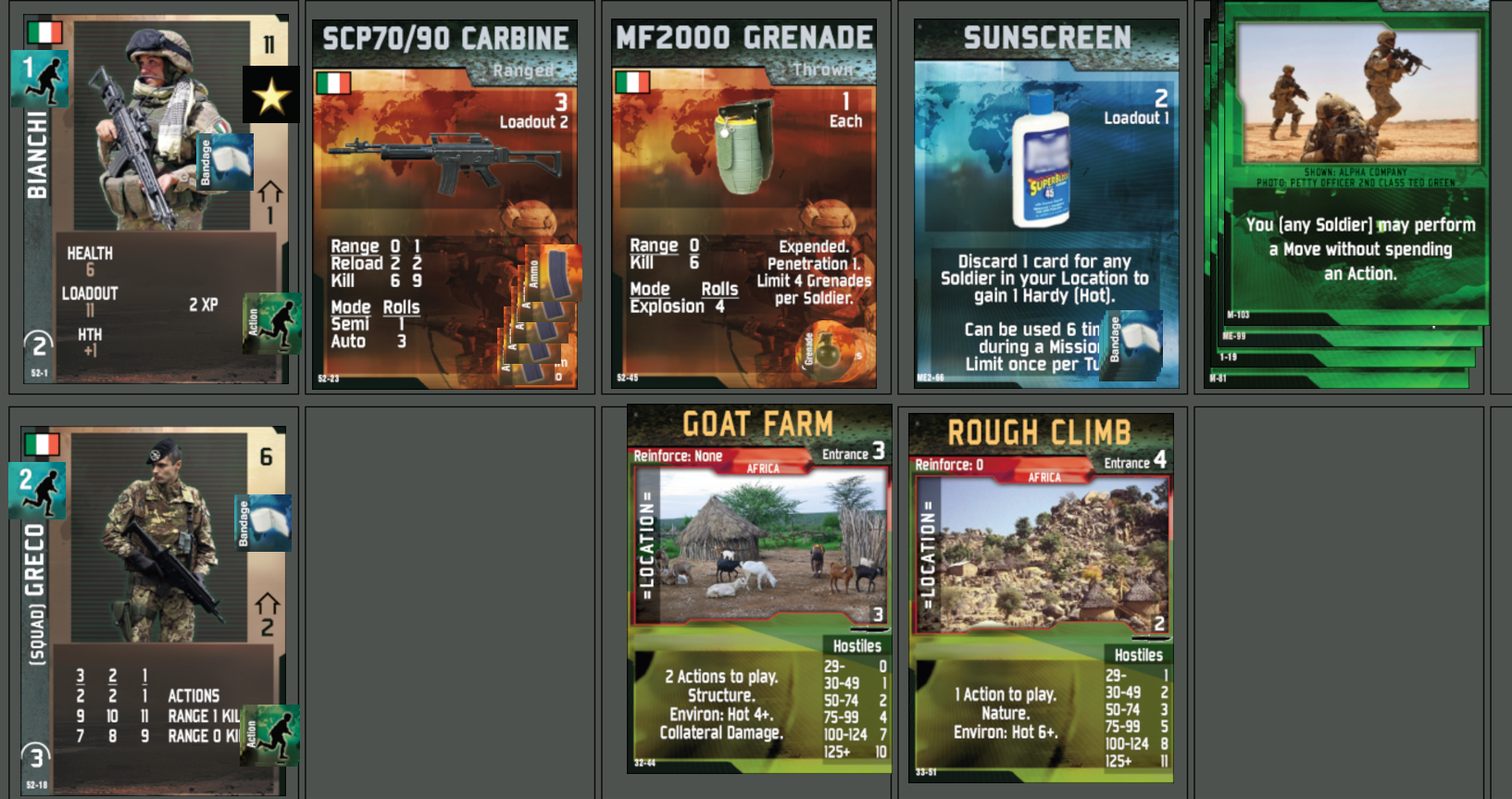
Soldier cards for the game Warfighter. Depicted are two soldiers with their equipment
Bianchi and Greco are all kitted out for a patrol in Africa. Bianchi is a player soldier and so has equipment. Greco is a squad soldier, and so is represented by the stats on the card. The image depicts two of the locations that could be played in the game, currently in Bianchi's hand

I clearly needed to read the rules properly, from cover to cover! I know that is cheating, but needs must where the devil drives. Reading the rules showed me that I had been playing the game wrong and making things much harder for myself than I needed to. Reading the BGG forum also showed me that I needed to think a bit differently about how I played. I played again after reading the rules and I won a game! I lost a couple more then I won another couple more. I was hooked.

I bought the WWII VASSAL set. Now I could try to fight the Germans in Norway in 1940. I lost a lot more. The Narvik expansion is hard with lots of elite Germans involved and blooming parachutists appearing behind your heroic Norwegian fighters. I opted for some easier games with the French fighting back against the Germans in France in 1940. I was still having fun. I have a dozen or so games under my belt now, and will be playing more.

The Game

There are plenty of reviews on BGG and in the wider internet about Warfighter that will tell you more about the game, so I won't labour the point here and just provide a broad overview. When setting up, you pick a mission, which will tell you how many points you have to spend on soldiers, how many turns you have to complete the objective, and how far along the movement track the objective is. You then pick an objective, which can be the Protect the Elephants one, or Kill the Drug Cartel Boss, or any number of military objectives. Some of these objectives are raids where you need to eliminate the baddies. Some are escape missions where you have to get to the objective and then back to your starting base.

Your team comprises Player Soldiers, Non-player Soldiers and Squad Soldiers. Player Soldiers are key to doing anything. They draw a hand of cards that you use for special effects or as discards to help you move from location to location. The locations you move to have to be drawn in this hand of cards too. Non-player Soldiers and Squad Soldiers are the supporting cast in your Player Soldier's drama. They provide additional firepower and soak up bullets that might otherwise be targeted at you.

Each mission involves moving along a location track. At the start of the game, you place the Mission card in the first spot on the track and the Objective card at a place specified by the Mission card. If the Mission card tells you to place the Objective in space 5, then that is where you place it. In this case, you would have three empty spaces between the Mission card and the Objective card. To move through these spaces, you need to play a location card, deal with any hostiles that are placed in it, and occupy it. Once you have troops on the location card, you can play the next one. Rinse and repeat until you reach the objective and complete whatever the objective says you have to do to, and then you will have won. Easy. Maybe. The locations can have their own special conditions that affect your progress, Many have reinforcements arriving every turn that can cause you problems. Some of them can be difficult to move into because they are bad terrain, so they slow you down. And so on.

Bianchi and Greco have been dropped into the patrol area by helicopter and have cleared the hostiles from the first location. They must now advance to the watering hole to save the elephants

By judicious play of the cards your Player Soldiers draw, hopefully you win more often than you lose, but sometimes you just draw all the wrong hostile cards, or you make a misstep that costs you badly, or the dice just roll 1s all the time. The randomness of the card draws mean that this game has a lot of replayability. You could play the same mission several times and move through completely different locations every time. Add to that all the gear and skills you can buy for your Player Soldiers, and the sheer number of options is hugely increased. It makes for quite a heady mix. The key thing is that good tactics in the game can get you through despite a run of bad luck. Having meaningful decisions to make is a nice change from a lot of solo games I have played, where you are basically a dice.rolling engine.

Another advantage of the game is the range of mission lengths, from 3 locations upwards. It's easy to pick a mission to suit your available time, be it half an hour or a whole day. You can also string missions together into a basic campaign format. I've not been following the campaign format in the rules, but have played several games with the same Mexican army team against drug cartels, and it is starting to feel like an informal campaign where the two main soldiers are developing their own characters and traits in my mind. Poor Diaz though. He gets wounded every single game. And I did have to retcon one game as a dream because the drug cartels turned up with two RPG teams that swiftly made mincemeat of my hero and her sidekick! Torres is clearly starting to crack after too much time in the jungle.

One other point worth mentioning is that the modern and the WWII versions feel different from each other so it is not a case of picking just one or the other game. There is value in both. The modern set also has the advantage of feeling like an action movie, with each location being a scene in that movie. Sending my Mexican kill team into the jungle to take out a drug cartel boss really did give me a Sicario vibe, and in the end, most solo games are about the stories we tell ourselves as we play.

The VASSAL Module

I'v never really been a huge fan of VASSAL. I love the concept of being able to play against players all over the world. I love the idea that you can play large games by email, and I have played VASL, the Advanced Squad Leader version, by email several times. But ... it always feels like something is missing when I set up a VASSAL game. So, how does Warfighter on VASSAL stack up?

You get almost all the expansions for a fraction of the price of the physical game. This means you can try all the parts of the game and then buy those you most want, if you decide to get the physical game at all. The Warfighter module is set up well and it is generally easy to find your way around it. It's easy to set up a game and leave it set up, and you never need to clear your game up from the dining table so you can eat. If space is an issue for you, then the VASSAL module should be a definite option, because the basic footprint of the game is about 3' x 2' or so, and possibly more with all the soldier cards and their kit laid out in front of you. That said, people have designed space-saving versions that you can read about and download on BGG, so the footprint of the game does not have to be a huge issue. One other good thing is that the VASSAL module includes the rules. You can click on the Rules button and read through them on the screen. Essentially, it is a complete game.

On the less good side, you lose the physicality of the game, which is an important factor for me. I get around it in part by rolling my own dice rather than using the VASSAL dice roller. Looking through the card decks can be a bit fiddly in VASSAL. There is a search function for finding specific cards in a deck, but you cannot easily spread the whole deck out in front of you when you have the option to pick any card from it. This also applies to choosing your force. Sometimes you just want to lay all the options out and compare them side by side. You can do this but it involves a lot of dragging and dropping followed by deleting those you do not want afterwards. That can be a lot of clicking. The biggest negative issue for me is screen size. Being able to see the whole gameboard at once in a readable format rather than having to zoom in and out can be problematic: I have a 27" main monitor, which is too small for larger games set at a readable zoom level.

Overall, the VASSAL module does well at providing a way to play the game and I am very pleased with my purchase. I find it useful to have multiple monitors, so that I can have the display with my soldiers on one screen and the main gameboard on the other, and I wish I had a larger main monitor, but it works and I look forward to playing this game a lot more.

Saturday, 29 January 2022

Heading for a Court Martial: Thunderbolt/Apache Leader (Dan Verssen Games) AAR

I decided to dig out Thunderbolt/Apache Leader (TAL) from Dan Verssen Games recently. It's another game I bought since moving to Norway, and, like Gloomhaven, it has the significant advantage that you can play a mission in half an hour, meaning that a campaign can be fitted easily into and around a busy week, provided that you have somewhere to leave it set up.

I've wanted this game since it first came out in 1991. Unfortunately, those were the days when I had more time than money, and little enough of either really. I played the original Hornet Leader that also came out in 1991 until the fateful day that my mother's dog ate my copy of that game, so I was aware of the system and knew that I got on with it. Still, it took thirty years before I found myself looking for more boardgames and jumped on TAL as one of my choices to fill my time.

I love what DVG has done with the game. The components are good quality and it comes with a mounted mapboard. I also like the new model hex tiles over the original game's cards. It's much more aesthetically pleasing. The only down side is the that the rulebook's structure and lack of an index makes looking things up quickly hard work. It's structured to fit with the game turn sequence, which is great, but that also means that information and rules can be scattered throughout the rules. It's not a dealbreaker for me, but it's a pain when coming back to the game after a break. It's a good job the rules are available as a free pdf, which makes looking things up much easier, although I play boardgames to get away from my electronic gizmos so it partially defeats the object. Still, it's helpful, and I don't need to check my tablet too often.

One of the other attractions of TAL is that it is not too serious, although you might not believe that from some of the posters on the BGG forum! The game reminds me of watching Airwolf or playing one of the various arcade machines where you fly around strafing the baddies. It's very Hollywood/videogame, and I love that. I mean, even the hex tiles for the terrain remind me of every canyon Airwolf ever flew down, while the ability to 'fly' A-10 Warthogs reminds me of the planes that used to fly over our house on the way to the bombing range so low they nearly took the chimney off every time. I guess this game has a fair bit of nostalgia going on too!

The game itself is a mix of management and tactics. You need to manage your pilots, planes and resource points (SO points), and you need to plot the best route through the enemy to maximise death and destruction. Getting the balance right to achieve victory is proving problematic for me so far, and the best rating I have achieved is 'Adequate', which feels more like damning with faint praise than a real success.

Pakistan 2013: Rapid Deployment

So, how does it play? I picked the theatre and the mission at random and wound up with what looks like a rather difficult mission, even though it is rated as standard. The problem here is that I don't get a lot of resources unless I pick old tech and the enemy forces get a lot of bonuses for movement, so they are likely to be right up in my face from the get go.

For my squadron, I pick:

  • 1 AH64 Apache (aka Airwolf!)
  • 2 A10 Thunderbolts

This does not feel like enough planes to take on the rapidly advancing enemy, but I hope the A10s pack enough punch to blunt their advance from day 1. Anything the Apache ... umm, sorry ... Airwolf does will be a bonus. I also buy a Scout which can increase my time over the battlefield if I am lucky.

All set up to play. Damage chits and Random enemy chits in the cups at the top

The planes are accompanied by a stable of pilots equal to the number of each type of plane plus one. I select pilots and choose not to downgrade or upgrade any of them.

I draw the special condition for the day. Turns out the enemy is particularly mobile and get yet another bonus for advancing on my airbase. That means that all the assault forces are guaranteed to advance and the support forces will advance most of the time with the command forces probably advancing. This is going to be a problem.

Enemy starting locations. Each range band they move closer to my Air Base, the harder things get

Then it is time to allocate planes and pilots to missions. I decide to attack the Fast Assault force, the Scout force and the Air Defence force. The Fast Assault force needs to go because it gets extra bonuses to move towards my lines and I cannot afford to have lots of enemies up in my face. If they get there, it increases the Stress my pilots suffer, which in turn increases their likelihood of becoming unavailable to fly. There are already enough modifiers that will lead to the enemy closing in on my, so they need to go. The other two are more vulnerable forces so I am focusing on them in the hope that I can destroy them more easily. That will reduce the number of targets I need to attack on Day 2. Ideally, some of the forces that give all those horrible bonuses will advance at the end of Day 1 and become more vulnerable to attack.

Day 1

So, time to arm my planes and enter the fray. I'm going to allocate 1 SO point to each plane which will buy me 10 points of weapons. That permits me a good number of Hellfire missiles and other better quality bombs and missiles, making Day 1 a bit easier.

First up is Gumby in an A10 versus the Air Defence force. The terrain is laid out and I dice for the locations of the baddies and it looks good. Looking at the (randomly determined) terrain layout and enemy deployment, combined with the 'Low Approach' Mission Event which means that the bad guys don't get to fire on turn 1, a clear tactic is evident. Gumby will use the ridge lines for cover and fly a low figure eight through the enemy. With a few decent dice rolls, he has a chance of taking out the whole force. We'll start by getting up close and personal with a SAM unit before it has a chance to fire. Those SAMs are quite lethal if I am not careful.

The flight goes substantially as expected. The enemy is caught by surprise and the Hellfires are on target, leaving a trail of carnage in Gumby's wake. The only problem is the SAM unit and an APC that take cover, meaning that Gumby will not be able to use Hellfire missiles on them. Instead, he has to get in and use his cannon. Unfortunately, he is not as good with cannon as he is at standing off and firing missiles, so it is a chancier attack. He flies in and misses the APC, leaving him vulnerable to attack by both it and the SAM unit. The choice of an ECM pod suddenly comes into its own. I roll unfeasibly high and both units find their attacks jammed and unable to lock. With his fuel low, Gumby gets up close and personal with the SAM unit and destroys it, before dodging some enemy fighters on his return to base.

Target destroyed, sir!

Next up is Pirate in an A10 versus the Scout force. Upon reflection, I think this was a mistake. Pirate should have attacked the Fast Assault force. Again, the terrain is laid out and the enemy deployed. The route through the enemy is less clear this time, but I plan a similar flight path to last time. In no time at all, the Scout force is scattered and Pirate is flying home.

Enemy destroyed, Sir!

The third mission for the day sees Judge flying an Apache in an attack on the Fast Assault force. I had thought he could hover and fire off the Hellfire missiles in a bid to take out half the force, which would then be ripe for picking off the next day. Unfortunately, he could not hit the broad side of a barn door and the enemy remained largely unscathed.

The enemy advance rapidly

The day ended with the enemy battalions advancing. Not unexpectedly, given all the modifiers, the assault battalions moved quickly towards my baseline and the support and command battalions seemed mostly keen to keep up.

Day 2

Day 2 dawned and my pilots were ready for their next mission. They even got an Email from Home (special condition for the day) that reduced their stress from the day before.

I needed to take out the Fast Assault force because it was closing in on my airbase. With the support battalions moving up, they had become better targets too and I could think about taking them out to slow down the advance by removing some of those modifiers that made it easier for the enemy to close on me.

So, I sent in Gumby to take on the Fast Assault force. He was having a bit of an off day though and only reduced it to half strength. Worse yet, the enemy got their eye in and punched all kinds of holes in his plane, but he still got it home.

Partial success. If you look at the sector map (top right) you can see that Battalion 9A has advanced  at the start of the day thanks to the special ability of the enemy Engineering unit

Flash got sent after the enemy Engineering Unit, because that one gave the enemy assault forces a free advance at the start of each day. Standing off in his Apache, he sent missile after missile at them and destroyed the battalion, although he took some damage that would soon be repaired.

Flash gives the enemy what for!

Pirate pitched up in his A10 with orders to take out the enemy Infantry Battalion. The initial approach went well, but he soon found himself outnumbered and outgunned. A lucky enemy shot saw him killed in his cockpit! Nothing you can do when you draw the 'Killed' chit from the damage pot.

Pirate's name is added to the squadron Roll of Honour

This was a bad day for mission events with my pilots encountering enemy fighters and enemy SAMs both on the way in and on the way home. I'm low on SO points with all the enemy on the doorstep of my base, so I'm going to have to focus on clearing up there before I can try anything fancy.

Day 3

As Day 3 dawns, I realise I am in trouble and see that I should have concentrated my forces better in the early stages. Better to kill units properly than spread my fire around. Worse yet, the special condition for the day is Enemy Advance. I choose to advance a command unit that was close to the rear, but it is still a less-than-ideal situation. I've not had the best random event draws so far with most going against me. Maybe today things will pick up.

So, Time to send Halo out to attack the Fast Assault force in an A10. It's at half strength so he should be ok. The mission goes as anticipated and Halo is able to finish off the force. Horray!

Flash heads out in an Apache to take on a Mixed Force. He should be less vulnerable to this force than to the Infantry Force (I thought!). My goal is to try to reduce it to half strength. I think destroying it is an unrealistic goal Unfortunately, things do not go to plan. It was not possible to position his Apache where it could avoid being shot at. The first shot wounds Flash and leaves him unable to fire on the first turn. Never mind. Try again. Bang! He is wounded again, killing him and his Apache crashes. He never even got a shot off.

Two pilots down, and two planes down. This is bad. I'm just lucky to have enough SO points to not suffer immediate defeat. I spend a tonne of victory points replacing the two destroyed aircraft and a tonne of SO points repairing damage. Meanwhile, the enemy is right outside my airbase and all up in my face.

Day 4

Day 4 was a mad scramble to keep things under control.

I sent Gumby out to take on one of the command forces. I figured it would be a reasonable chance of getting at least half victory points. As it turned out, Gumby was able to annihilate the whole force, although his plane came home with a tonne of bullet holes in it. I'm going to have to claim this one on insurance, I think.

I send out  an Apache and a Thunderbolt (piloted by my new pilot, Thor) against the infantry force that had killed Pirate. They piled into the combat area and started laying around them with Hellfire missiles, cannon rounds and anything else they could drop. The enemy battalion was destroyed but both pilots returned home with planes that looked like lace hankies more than they did combat aircraft. Thor was definitely going to need a week off after this. Good job they build those Thunderbolts solidly but I see another insurance claim in the offing.

Game end

With two battalions destroyed on the last day, I totted up the points. My score of 10 points gave me a Dismal rating, but at least I did not lose. In retrospect, I should not have bothered buying an extra Thunderbolt pilot to replace Pirate. Not spending that point would have raised my rating from Dismal to merely Poor.

Final Thoughts

Well, wasn't that a fine mess I made? Hardly my finest hour, but I had fun and I can safely blame the mission event cards and the damage chits for my worst failures. It felt like every flight was either sent bad coordinates or encountered enemy anti-aircraft fire heading to or from the target. Similarly, the damage chits were all quite serious, and my ECM barely functioned after the first day. I'm definitely taking the ECM back to Toys R Us and demanding a refund. The special conditions were more balanced and helped keep me in the game though.

This is a game I can pick up whenever I feel like without worrying that I need to completely relearn the rules. The tactics, on the other hand, are something I need to work on. It can be hard balancing needing to damage as many enemy battalions as possible with needing to concentrate my firepower to fully destroy them.

I do need to try using more different aircraft, but, honestly, I only got the game because I wanted to fly Thunderbolts, and to a lesser extent Apaches.

There is little to differentiate the different theatres other than the technology at the date the campaign is set, so Libya is the same as Pakistan is the same as the North Atlantic WW3. That means that the scene setting has to happen in your head. Fortunately, the different missions do feel different. The Rapid Deployment mission feels different from the Surge mission, for example. Despite the lack of differentiation in the theatres, the mix of aircraft and missions is sufficient to provide enough variety straight out of the box without buying any of the expansions. Overall, this is a great fun game. It's cinematic, arcade action on the tabletop and just what the doctor ordered. Now, do I set up for a different campaign or try something different next?

Saturday, 30 October 2021

Gloomhaven - Euro dungeon adventuring (Cephalofair)

I've been playing a lot of Gloomhaven since I moved to Norway. If you've missed the hype, it's a Euro-style dungeon bash game with a big campaign and a legacy mechanic that changes the game permanently as you adventure. It also weighs 10kg, which nearly killed me getting it up the hill to my flat. It has two things I particularly like about it.

The first is that each dungeon you enter is a puzzle to be solved. You have a limited number of actions for the scenario defined by how many cards you get in your hand. Some character classes get more cards, but the effect is balanced overall by the power and synergies between cards. This means that you have to find the most effective and efficient way through the dungeon for the combination of characters in your party.

The Gloomhaven board at the end of my campaign

The second is the legacy mechanic. I get to stick stickers on the main gameboard and on the cards in each character's decks. Sticking stickers down is fun. The stickers on the board are for dungeon locations that I have made accessible to my party, and for global achievements that affect the larger campaign. When I first set out to play the campaign, I thought I should get card sleeves so that I could remove enhancement stickers if I decided to reset the game, and removable stickers for the board. In the end, I did not. If I want to reset the whole campaign, I can use one or more of the many apps and websites to record progress instead. Enhancements on the character cards are limited and generally expensive, so I figure I can just dial up the difficulty for scenarios, if the enhancements make them too easy. I also don't see me returning quickly to Gloomhaven to play a full campaign now that I have finished the current one, simply because it's a huge undertaking that has taken me 18 months to complete with regular game play. So, that means that stickering and enhancements are not really an issue.

I have recorded 145 plays of Gloomhaven since getting the game. These are all solo scenarios, and many were losses. Especially in the early days, it took me several goes to 'solve' the scenarios I was playing. I am still very keen on the game, even after all these plays. It's fun, engaging and challenging, which is not always the case with games played solo, and it still feels quite fresh. This is partly because of the way the scenarios are created. There are 'kill all the monster' scenarios, but there are others with different objectives, so each game can be different. The game also remains fresh because there are a lot of different character classes to try. Each character gets a personal goal when it starts and will retire once that is achieved. This leaves you free to try different character classes as the game progresses. I mean, you could stick to the same class and start a new character of the same class as the one you have just retired, but where is the fun in that?

One other advantage of the game is that scenarios can be quite quick, so it is easy to fit a game in of a weekday evening when you have a spare moment. This fits well with where my life is at. I can leave most of the game set up and run through a scenario in an evening if the mood takes me. It helps keep the momentum going.

Overall, this is a game I would recommend. It's not your typical dungeon crawl. It feels more like a video game where you try to solve the level by finding the most efficient way through it. Each of the character classes is different, some being more difficult to play effectively than others, and with different strengths and weaknesses. It's also cooperative and I am much more interested in cooperative games than competitive ones these days. Given how much I have got out of this game, it may well be one of my best purchases after Advanced Squad Leader.

Having played little but Gloomhaven for 18 months now, it is time for a change. Still, I do have plans for the game components. I just received the pdf of Fantasy Fistful of Lead in advance of them sending me the hardcopy rules, and I think that my Gloomhaven tiles, figures and standees may well see the table as FFoL teams and monsters once I have read the rules. Playing fantasy skirmish games with the components was certainly in my mind when I bought Gloomhaven originally and it is something I intend to try at some point in the near future.

Saturday, 21 August 2021

RAF: The Battle of Britain 1940 (Decision Games)

 September 6 1940

A hectic day with half a dozen raids, mostly focused on John's gaming shed near Canterbury. The Luftwaffe has been gunning for that shed since the start of their attempt to grind the RAF into the ground and pave the way for Operation Sealion. It was a good day for the RAF. Losses were low and enemy losses were high. And the shed was still standing despite a month of attempts to bomb it.

September 7 1940


My campaign was over. It had been hard fought, especially in the beginning, but the might of the Luftwaffe had been thrown back by the heroic pilots of Fighter Command just a few days after the Luftwaffe terror campaign had begun. In this version of reality, there was no Blitz. London was never even attacked. Kent was the real focus of the Luftwaffe's ire. I've no idea why I drew so many target cards for Kent, unless it really all was about the gaming shed after all.

I used to own the original version of this game many years ago, about the time it first came out. I played it a bit but never finished the whole campaign, and can only assume that I sold it somewhere along the way, although it is possible my mother's dog ate it, like it did to my copy of Hornet Leader. With the new version of the game in hand, and more time for gaming, I sat down a week ago to first learn the rules and then to play the campaign from the perspective of Fighter Command.

The rules were easy to follow, and it was simple to set the game up and learn by following the sequence of play. I then set up again to try the shorter campaign covering the first four raid days of the campaign (days on which raids happened). Things were looking bad after just those few raids but not hopeless, so I decided to continue the full campaign. As I gained experience with the game, things started getting better. I stopped trying to stop every raid, and started focusing on those where I thought I might do most damage. The Luftwaffe started getting worn down and my new approach paid dividends in fewer of my own planes getting shot down. Suddenly, the two factors led to a snowballing of victory points and on September 6th 1940, I reached the critical victory point score. I had won the game. This took me about a week and ten raid days.

The game is quite repetitive in that you draw a target card and roll to see whether this is a real raid, a minor raid or a major raid. Then you dice to see what warning you get of the raid and how accurate that warning is. The point at which you deploy your fighters and find out what the raid consists of depends upon what level of warning you get. Which of your fighters you can deploy depends upon how early the warning is. It is possible to get no warning, where only fighters actually on patrol on the raid's flight path can deploy against it, to very early warning so you can call in the fighters from all the surrounding airfields.

With both fighters deployed and the raiding aircraft identified, you have to fight your way through the fighter screen before you can attack the bombers. There are random raid events along the way and much of the narrative is driven by card draws for events on the approach, at the target and at the end of each day. With the raid outcome determined for good or ill, you start all over again with the same process, only this time some or all of your pilots could be refuelling and rearming their planes and unable to respond. It is also possible to have multiple raids happening at the same time, either as follow-up raids or in different areas. I think my record in this campaign was four follow-up raids on John's gaming shed, or RAF Hornchurch as the cards called it. By the end of all this action in the one place, I had no fighters left able to respond from any of the surrounding areas and the bombs were falling thick and fast around the shed.

I've seen some complain about the sheer repetitiveness of the game but I found that it was not an issue. I played a raid day or two every night and was soon looking forward to returning to the table and seeing what would happen next. The relentness repetitiveness of the raids was what built the tension in the game as I tried to work out where the next attack would be and which fighters I needed to send up on patrol. If I sent the wrong ones up now, they would not be available in an hour's time if there were a raid over their sector then instead. Likewise, do I send supporting fighters from a neighbouring sector, or will I need them for the next raid? It's very much a resource and risk management game, and I enjoyed it a lot.

I also like that the new edition allows you to play as the Luftwaffe and to play it as a two-player game. I don't particularly have any desire to play the Luftwaffe in this, having grown up thrilling to the sound of Spitfires and Hurricanes at air shows and on a diet of movies like The Battle of Britain and Angels One Five, but I do like having the option. The two-player option offers an interesting challenge too, because a human player is unlikely to manage resources in the same way as the game's AI.

Saturday, 14 August 2021

Heroes of Telemark (Decision Games)

I remember watching The Heroes of Telemark on the TV many years ago. It wasn't a movie that really stayed with me, just another in a long line of WW2 movies that formed a large part of my diet as a child. Still, I remembered it enough that I was reminded of it in 2020 when I moved to Stavanger. It turned out that my flat would be next to the graveyard where the dead from Operation Freshman were buried. This made me reflect on the movie and on the reality of this period, although I don't have any great insights to offer. It's just a purely personal reflection on the morality of wargaming generally, my relationship to the past, and my reasons for not usually gaming anything more recent than WW2 these days. If you want more depth and discussion of these topics, I recommend the Polemarch blog instead. The discussions about the morality and philosophy of wargaming there are very interesting.

Eiganes cemetery in Stavanger is home to more than just the members of Operation Freshman. Solveig Bergslien, a member of the Norwegian resistance who died in a Gestapo cell, has her grave here, and there are the graves of Soviet soldiers who died in Rogaland, as well as the Norwegian war dead. Visiting the cemetery really does make you think, but that's not the point of this post.

I picked up Decision Games' Heroes of Telemark, Commando Raids in Norway, 1942-43 recently as part of my quest for more solitaire wargames. I felt a bit weird about it because of my proximity to the dead from one of the raids depicted in the game, but pushed past that and tried it out. It's an interesting game with only four pages of core rules and two of game-specific rules. Knowing the core rules makes other games in this series more accessible because you only need to take on board the game specific rules then.

The game itself has a small footprint (about A3 but actually one of those funny American paper sizes). This makes it ideal for the space-challenged. The map depicts Telemark (if I have done it right, this link should show you the map area on Google Maps), where the heavy water plant was.

The game offers four scenarios that can be played in turn: Operations Grouse, Freshman, Gunnerside and Tinnsjo. Played in order, these set up the narrative of the WW2 operations, but they can also be played in a random order if you just want a slightly different campaign. Success in one operation will increase your chance of encountering Germans in later operations, so the difficulty of each game ramps up through the campaign. You can replay operations if you lose them, but if you lose two operations, the campaign is over and you have failed.

Game length is determined by the number of event cards in a deck. This number is set by the scenario but can go up or down as you encounter and defeat or lose to German patrols. You draw one card each turn and the game is over when the last card is drawn.

Each scenario also gives you recruit points to buy troops and gear. These start in Britain and arrive on the map either by glider landing or parachute according to what type of troops they are. Then you have to move to the various objectives and reveal them. Once revealed, you can capture some of them, destroy others, or find that you have been ambushed and must fight. Operation Grouse requires you to scout the objectives. The other operations are about capturing plutonium or destroying heavy water plants and resources.

In my first game, my entire force was wiped out by an encounter with a massive German patrol. I then moved on to the campaign, having worked out the rules. I succeeded easily in Operation Grouse, encountering little resistance and dodging an ambush by scouting an objective from an adjacent space with my Commandos. Unfortunately, I lost most of my troops to an enemy encounter in Operation Freshman but still managed to win the operation. My engineers all died when my gliders crashed in Operation Gunnerside; they did not even make it onto the map, in a repeat of the historical Operation Freshman. My second try at this operation was a success and I moved on to Operation Tinnsjo, which I lost because of massive hostile activity, and thus I lost the campaign.

Despite my being a bit weirded out by being too close to elements of this game's subject matter, this is an interesting game. It is very random in that your encounters with the Germans can be overwhelming if you roll high for the number of Germans present or they can be a walkover if you roll low. The random distribution of your base and the objectives will also affect how easy or difficult your game is.  However, this just means that you need to manage your risks as best you can and the meaningful choices in the game are made around that risk management, while the pressure to push your luck is provided by drawing the event cards and counting down to the end of the game. The combination of these elements and the short playing time for each operation make the game highly replayable, although I would not want to play it exclusively.

For me, it is a good filler game for when I don't want to, or don't have the time to, sit down for a couple of hours with something meatier. The main down side of this game is that I found the rules a little messy. Despite being short, or perhaps because of that, it took me a little while to piece together how to play.

I have two more of Decision Games' solitaire games: Vikings: Scourge of the North and Border War: Angola Raiders. I expect more of the same from each of these, and look forward to trying them out in the future.